Identifying Individual and Environmental Antecedents of Harmful Academic Behaviors: A Qualitative Content Analysis of Research and Scientific Documents
Keywords:
harmful academic behaviors, individual antecedents, environmental factors, academic integrity, qualitative content analysis, documentary studyAbstract
This study aimed to identify and classify the individual and environmental antecedents of harmful academic behaviors through qualitative content analysis of research and scientific documents. The study was applied in purpose and documentary-qualitative in design. Scientific literature concerning academic procrastination, academic dishonesty, self-regulation, self-efficacy, emotion regulation, teacher–student relationships, peer relations, parental involvement, school climate, and technology-mediated misconduct was examined. Relevant concepts were extracted, coded, compared, and consolidated into conceptually coherent categories. Five overarching domains emerged: individual factors; family and interpersonal factors; school-level factors; organizational and contextual factors; and situational and technological factors. Individual factors encompassed students’ cognitive, motivational, emotional, ethical, and behavioral characteristics. Family and interpersonal factors concerned relational quality, social support, parental expectations, and peer norms. School-level factors included teacher–student relationships, instructional design, assessment, feedback, and classroom management. Organizational and contextual factors referred to institutional climate, fairness, safety, resources, and academic pressure, whereas situational and technological factors concerned opportunities for misconduct, digital distraction, access to ready-made answers, and rules governing technology and artificial intelligence. The findings indicate that harmful academic behaviors are multidimensional phenomena arising from interactions among personal vulnerabilities, relational processes, educational conditions, and situational opportunities. Effective prevention therefore requires coordinated, multilevel action that strengthens student capacities, improves family and school relationships, and reduces contextual conditions that facilitate harmful behavior.
Show full article content
Introduction
Harmful academic behaviors constitute a significant educational and psychological concern because they can interfere with learning processes, compromise academic integrity, weaken students’ relationships with teachers and peers, and gradually undermine the developmental functions of schooling. In the present study, the concept of harmful academic behaviors is used as a multidimensional construct encompassing behaviors such as academic procrastination, academic dishonesty, avoidance of educational responsibilities, violation of academic norms, disruption of learning activities, and other patterns that hinder constructive participation in education. This conceptualization is consistent with efforts to develop and psychometrically evaluate measures that distinguish harmful academic behaviors from simple academic underachievement or temporary disengagement (1). Academic engagement itself includes behavioral, emotional, and cognitive dimensions and represents the quality of students’ involvement in learning rather than merely the absence of misconduct (2). Therefore, harmful academic behavior should not be understood as a single type of undesirable conduct or as an automatic consequence of poor academic performance; rather, it is a heterogeneous phenomenon whose manifestations may originate from different combinations of psychological, interpersonal, institutional, and situational antecedents. This distinction is particularly important during childhood and adolescence, when academic conduct develops within intertwined personal, family, peer, school, and cultural systems. From a bioecological perspective, student development reflects continuing transactions between individual characteristics and multiple layers of the surrounding environment (3). Consequently, explaining harmful academic behaviors requires moving beyond interpretations that attribute them solely to students’ motivation, morality, or personal responsibility and toward an integrated examination of the conditions under which maladaptive academic responses become more probable. This multilevel orientation is also especially relevant to contemporary Iranian adolescents, whose educational experiences occur within a complex intersection of psychological, familial, social, cultural, and educational pressures (4).
Among the individual antecedents of harmful academic behavior, problems in self-regulation occupy a particularly important position. Procrastination has long been described as a quintessential failure of self-regulation in which an intended course of action is voluntarily delayed despite awareness that the delay is likely to produce negative consequences (5). More recent evidence demonstrates that procrastination is not reducible to poor time management; it may involve cognitive control, motivational processes, emotion regulation, executive functioning, and the ability to maintain goal-directed behavior under conditions of difficulty or discomfort. A systematic review of self-regulated learning and executive functions indicates that planning, inhibition, monitoring, cognitive flexibility, and related executive capacities are closely intertwined with students’ management of learning activities (6). Consistent with this account, evidence among secondary-school students indicates that cognitive control may be related to academic procrastination through the mediating role of self-regulation (7). Research with junior high school students has similarly shown that academic delay of gratification and self-regulated learning provide important explanatory pathways in understanding active academic procrastination (8). These findings imply that postponement, incomplete academic work, and avoidance of difficult learning tasks may reflect difficulties in translating intentions into sustained goal-directed behavior rather than simple unwillingness to study. Reviews of the causal factors and interventions associated with procrastination further demonstrate that the behavior emerges from interacting cognitive, affective, motivational, behavioral, and contextual influences (9), while educational strategies directed at reducing procrastination emphasize planning, goal setting, behavioral management, and improvement of learning habits (10). Thus, self-regulatory capacity provides a central but not sufficient explanatory component of harmful academic behavior.
Emotional processes further clarify why some students delay, withdraw from, or respond maladaptively to academic demands. Procrastination may serve an immediate emotion-regulation function because avoiding an unpleasant task temporarily reduces anxiety, frustration, boredom, or feelings of incompetence, even though this short-term relief may intensify longer-term difficulties (11). This mechanism helps explain why academic avoidance can persist despite students’ awareness of its negative consequences. Recent evidence has shown that academic self-efficacy and difficulties in emotion regulation are important predictors of academic procrastination (12). Similarly, teachers’ academic motivation may be associated with students’ procrastination through processes involving emotion regulation and study habits, suggesting that students’ regulatory behavior is partly embedded in the instructional environment (13). Academic self-efficacy is particularly relevant because students who doubt their capacity to perform successfully may experience difficult tasks as threatening and become more likely to disengage or postpone them. In Iranian students, meaning-based education has been reported to reduce academic procrastination while improving academic self-efficacy (14). Perceived teacher support may likewise reduce procrastination through stronger academic self-efficacy, although such pathways may vary according to student characteristics such as gender (15). Research among primary-school students has also demonstrated that perceived teacher support can influence academic anxiety through sequential associations involving self-efficacy and procrastination (16). These findings indicate that harmful academic responses arise not simply from internal deficits but from students’ interpretations of their competence, their emotional responses to demands, and the degree of support available within their educational environment.
Motivation represents another key component in the emergence of harmful academic behaviors. Expectancy–value perspectives emphasize that students’ achievement choices, persistence, and effort depend substantially on beliefs about competence, expectations of success, subjective task value, and the perceived costs of engagement (17). When academic activities are experienced as meaningless, excessively difficult, or primarily associated with external pressure and evaluation, students may be more inclined toward avoidance, procrastination, disengagement, or instrumental strategies designed merely to obtain desired grades. Academic pressure itself has important psychological implications; systematic evidence demonstrates associations between academic pressure and a range of mental health difficulties among adolescents (18). Such pressure may become particularly problematic when performance is emphasized without adequate emotional, instructional, or relational support. Interventions designed to reduce procrastination therefore cannot focus only on individual discipline; classroom-level changes involving task design, instructional support, and motivational conditions may also be required (19). From this perspective, students’ harmful academic behaviors can be interpreted partly as responses to the way educational demands are appraised and managed. High expectations may promote achievement when accompanied by support, competence, and meaningful goals, whereas excessive pressure, fear of failure, or persistent comparison may increase the appeal of avoidance or other maladaptive coping strategies.
Academic dishonesty represents another important manifestation of harmful academic behavior and involves somewhat different, although overlapping, mechanisms. Motivational models of cheating suggest that students’ decisions to engage in dishonest behavior depend on achievement goals, perceived competence, classroom goal structures, anticipated consequences, and interpretations of academic success (20). Meta-analytic evidence further indicates that academic dishonesty is associated with personality characteristics, attitudes toward cheating, and demographic factors, demonstrating that misconduct cannot be explained through a single moral or dispositional variable (21). The moral meaning assigned to dishonest conduct is also developmentally relevant. Moral-development perspectives emphasize that children and adolescents differentiate moral concerns involving justice and harm from social conventions and personal choices, making the internalization and interpretation of educational rules crucial to academic conduct (22). Studies of elementary-school children show that students are capable of distinguishing different forms of academic dishonesty and assigning moral evaluations to cheating behaviors (23). Experimental and behavioral research in childhood has also indicated relationships between broader problem behaviors and dishonest performance in simulated academic contexts (24). These findings suggest that harmful academic conduct develops before higher education and that prevention efforts should begin early by strengthening moral reasoning, responsibility, self-regulation, and clarity regarding academic norms.
At the same time, dishonesty is strongly influenced by the social environment. One of the most consistent findings in the literature concerns perceived peer cheating: students who believe that peers commonly engage in academic dishonesty are themselves more likely to report or demonstrate dishonest behavior, although the magnitude of this relationship may vary across cultural contexts (25). Peer behavior may operate through descriptive norms, social modeling, normalization, perceived fairness, and beliefs that misconduct is necessary to remain competitive. Consequently, the presence of academic misconduct within a peer group can gradually alter perceptions of what constitutes acceptable academic behavior. Interpersonal relationships more broadly may influence emotional security, belonging, behavioral norms, and students’ willingness to seek legitimate assistance when difficulties arise. School climate research emphasizes that students’ experiences of relationships, safety, fairness, teaching and learning, and institutional environment are meaningfully associated with educational and developmental outcomes (26). Recent evidence similarly suggests that the relational dimension of school climate plays an important role in students’ social and emotional skills (27). Thus, peer norms and interpersonal climate can either strengthen the internalization of academic values or create social conditions in which avoidance, rule violation, or misconduct becomes increasingly normalized.
The family constitutes another central developmental environment shaping students’ academic behavior. Parental involvement can promote achievement and psychological well-being when it communicates emotional support, interest, structure, and appropriate expectations rather than intrusive control (28). More specifically, parental bonding may influence harmful academic behaviors through emotional security and academic self-regulation, illustrating the importance of indirect developmental pathways between the family environment and students’ conduct at school (29). Family expectations may motivate persistence, but excessive emphasis on grades, criticism following failure, inconsistent monitoring, or psychologically controlling involvement may increase fear of failure and maladaptive coping. The quality and developmental appropriateness of parental involvement are therefore more informative than the mere quantity of parental supervision. Family processes also interact with school and peer experiences, meaning that supportive parenting may buffer the effects of academic stress or difficult school experiences, whereas relational insecurity may amplify them. This interactive interpretation is consistent with ecological approaches in which the impact of any one environment depends partly on conditions operating within other developmental contexts.
Within schools, teacher–student relationships are among the most influential relational conditions associated with motivation, engagement, emotional adjustment, and academic functioning. A systematic second-order meta-analytic review has demonstrated meaningful relationships between teacher–student relationships and a range of student outcomes, underscoring the importance of relational quality as a core feature of educational environments (30). Longitudinal evidence likewise indicates that teacher–student relationships are associated with school outcomes in both typical and vulnerable student populations (31). Nevertheless, the construct is multidimensional, and studies differ in whether they emphasize support, closeness, conflict, relatedness, instructional assistance, or students’ perceptions of teacher behavior; therefore, conceptual precision remains essential (32). Anxiety is particularly relevant within these relationships, as supportive teacher interactions may provide security and facilitate adaptive help-seeking, while conflictual or threatening interactions may intensify school-related distress (33). Iranian evidence has specifically examined teacher–student relationship quality and academic procrastination as predictors of violations of academic norms among lower-secondary students (34). Together, these findings suggest that harmful academic behaviors may become more likely when students experience low relational support, unclear expectations, perceived injustice, or persistent conflict, particularly when individual regulatory vulnerabilities are already present.
The broader structure and organization of school also warrant consideration. School climate involves institutional norms, relationships, safety, teaching and learning practices, and organizational conditions that collectively shape students’ daily experiences (26). Even structural features such as school size may affect student participation and sense of community, indicating that organizational context can influence the quality of students’ connection with school (35). Rules concerning academic conduct are also likely to be more effective when they are transparent, consistently enforced, developmentally understandable, and perceived as legitimate. Conversely, ambiguous policies, inconsistent consequences, inadequate supervision, excessive competition, and weak institutional belonging may create environments in which harmful behavior becomes easier to rationalize or perform. The interaction between school structures and students’ personal characteristics therefore becomes particularly important: the same self-regulatory difficulty, anxiety, or temptation may lead to different behavioral outcomes depending on whether the surrounding environment provides support, supervision, belonging, and clear expectations.
The rapid expansion of digital learning technologies and generative artificial intelligence has added a new situational layer to the study of harmful academic behaviors. Digital resources can improve access to knowledge and support individualized learning, but they also create new opportunities for unauthorized assistance, unattributed content generation, copying, and dependence on ready-made answers. Research on ethical dilemmas in digital learning environments shows that academic misconduct is increasingly intertwined with students’ interpretations of appropriate technology use, institutional rules, and the perceived boundaries between legitimate assistance and dishonest practice (36). Systematic reviews of generative AI and academic integrity have similarly identified concerns regarding authorship, plagiarism, assessment validity, dependence on AI-generated responses, and uncertainty concerning acceptable use (37). More recent synthesis indicates that academic integrity and misconduct involving artificial intelligence require consideration not only of detection but also of assessment design, educational policy, student literacy, and institutional expectations (38). At the same time, attempts to balance academic integrity with productive use of generative AI emphasize that prohibition alone is unlikely to provide an adequate educational response; clear guidance, AI literacy, ethical instruction, and appropriately designed assessment are also needed (39). Although much of this literature has emerged from higher education, the increasing exposure of school-age students to generative technologies makes technological and situational antecedents increasingly relevant to the conceptualization of harmful academic behavior.
The diversity of these findings demonstrates that harmful academic behaviors cannot be adequately understood through isolated variables. Procrastination may be strongly associated with self-regulation, emotional avoidance, self-efficacy, and task appraisal, whereas cheating may be more strongly related to moral attitudes, peer norms, achievement pressures, institutional rules, and situational opportunity. Nonetheless, these behavioral manifestations share important antecedents and may coexist within the same student. For example, insufficient self-regulation may interact with demanding tasks and low teacher support to produce procrastination, while the resulting time pressure may subsequently increase the attractiveness of dishonest shortcuts. Likewise, excessive academic pressure may contribute to both avoidance and misconduct depending on students’ coping resources and perceived opportunities. This complexity highlights the importance of distinguishing antecedents from outcomes and recognizing reciprocal relationships among personal capacities, relationships, school conditions, and situational opportunities. It also supports the need for a framework capable of integrating cognitive, motivational, emotional, moral, interpersonal, organizational, and technological factors rather than examining each as an independent explanation.
Despite the substantial literature on particular forms of academic difficulty, research remains fragmented across relatively separate traditions focusing on procrastination, academic dishonesty, self-regulation, teacher–student relationships, family processes, school climate, or technology-mediated misconduct. Quantitative studies are particularly valuable for testing predetermined relationships, but they may provide only partial representations when the central problem is one of conceptual integration and classification. Qualitative content analysis provides an appropriate strategy for systematically extracting meanings and recurring concepts from scientific texts and organizing them into progressively more abstract categories (40). The approach enables researchers to move from individual textual units to subcategories and broader conceptual domains while maintaining systematic links between interpretations and source material (41). Such an approach is particularly valuable when the aim is not to estimate a pooled effect size but to synthesize heterogeneous evidence and develop an integrated conceptual framework. In the present manuscript, harmful academic behaviors are explicitly approached as multidimensional phenomena arising from interactions among personal vulnerabilities, relational processes, educational conditions, organizational characteristics, and situational opportunities, rather than as consequences of a single student characteristic.
Accordingly, the aim of the present study was to identify and classify the individual and environmental antecedents of harmful academic behaviors through qualitative content analysis of research and scientific documents and to organize these antecedents within an integrated multilevel conceptual framework.
Methods and Materials
This applied qualitative study used documentary content analysis. Scientific texts were treated as the research data, and concepts relevant to harmful academic behaviors were identified through systematic reading, coding, comparison, and categorization. The analytic process followed the three broad phases of preparation, organization, and reporting proposed for qualitative content analysis. An inductive orientation was used: the final categories were developed from the selected literature rather than imposed as fixed classes before examination.
The documentary corpus included empirical articles, reviews, books, and conceptual works concerning harmful academic behaviors and their plausible antecedents. The focal literatures covered academic procrastination, academic dishonesty, self-regulation, executive functioning, self-efficacy, emotion regulation, teacher–student relationships, peer relationships, parental involvement, school climate, assessment conditions, and technology-mediated misconduct. Targeted searches were conducted across Scopus, Web of Science, ERIC, PubMed, and Google Scholar using combinations of relevant English and Persian terms. Because the purpose was conceptual integration rather than effect-size estimation, the search was purposive and iterative rather than a formal systematic review.
Documents were retained when they directly informed the research question, reported sufficient methodological or conceptual information for appraisal, focused on school-age learners or offered defensible evidence concerning childhood and adolescence, and could be traced to an identifiable scholarly publication. Sources without adequate topical relevance, with unclear scholarly provenance, or concerning populations whose findings could not reasonably inform school-age education were excluded. Throughout screening and analysis, harmful behaviors were distinguished from outcomes such as poor achievement and low engagement.
Eligible documents were read in full or in relevant sections. Statements concerning personal and environmental antecedents were coded, and semantically similar codes were grouped into subcategories and overarching categories. Relationships among individual, family, interpersonal, school, organizational, and situational conditions were then examined. Bibliographic information, coding decisions, and supporting evidence were recorded to improve analytic transparency. The resulting categories are therefore an interpretive synthesis of selected scientific documents; they are not interview findings and do not establish causal effects.
Findings and Results
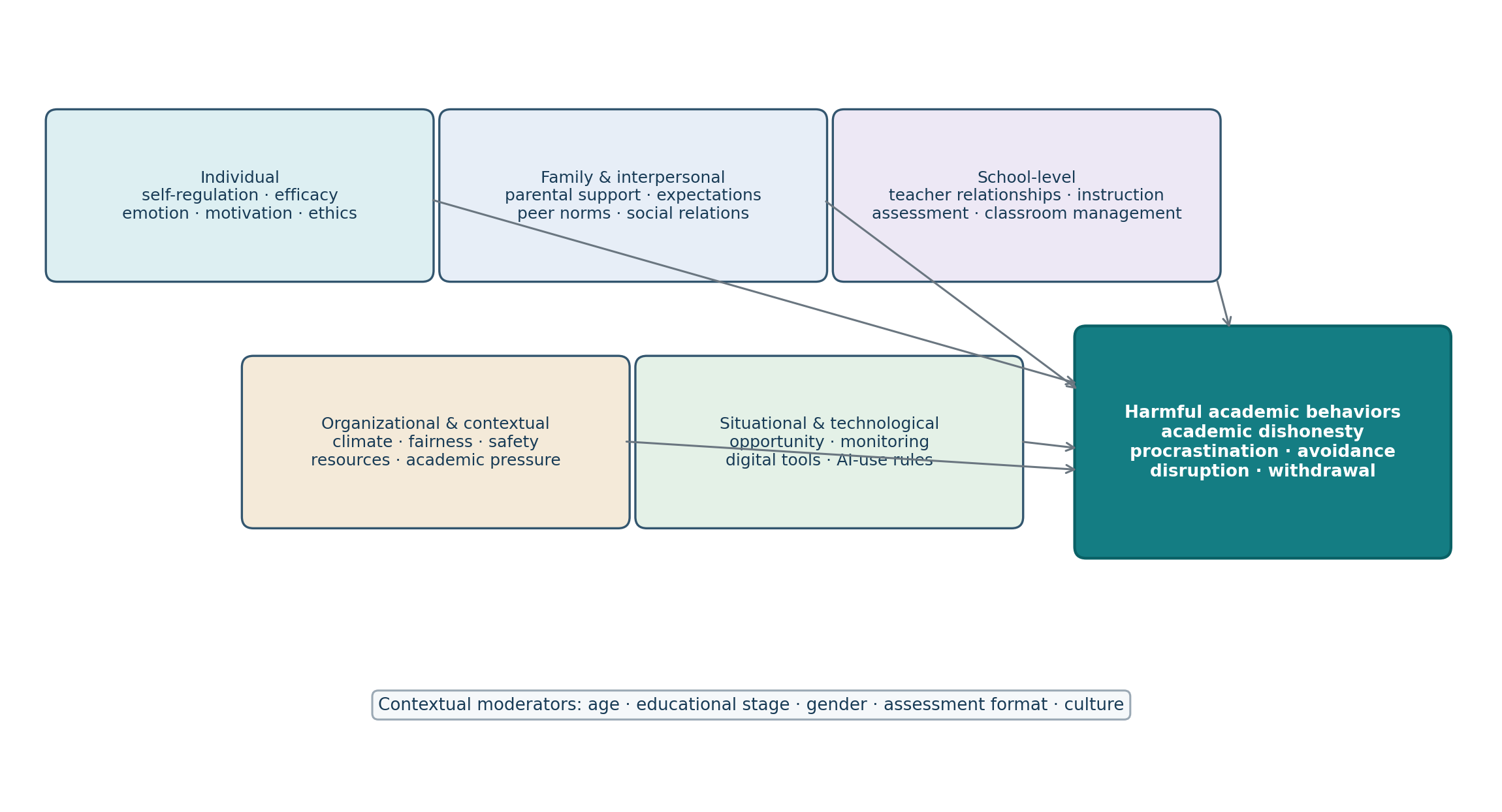
The classification showed that harmful academic behaviors cannot be attributed solely to personality or individual choice. Rather, they arise within an interacting system of cognitive, emotional, motivational, ethical, family, interpersonal, school, organizational, and situational influences. The extracted codes were organized into five overarching domains: (a) individual factors, (b) family and interpersonal factors, (c) school-level factors, (d) organizational and contextual factors, and (e) situational and technological factors. The detailed coding structure is presented in Tables 1–3.
At the individual level, academic self-efficacy, self-regulation, executive functioning, emotion regulation, motivation, achievement goals, and ethical attitudes were prominent. Difficulties in planning, time management, impulse control, and performance monitoring can make demanding assignments and evaluation pressure more difficult to manage. Low self-efficacy and fear of failure may intensify perceived incapacity, while poor emotion regulation can promote short-term avoidance of anxiety, frustration, or fatigue. These pathways are consistent with theories of self-regulated learning and the affective nature of procrastination, but no single factor is sufficient or universal (5-7, 11).
Motivational and moral components add another layer. When grades, social approval, or avoidance of failure dominate over learning and competence, maladaptive strategies may become more attractive. Favorable attitudes toward cheating, normalization of violations, and moral rationalization can weaken internal barriers to misconduct. Academic dishonesty is thus not simply evidence of deficient knowledge; it may reflect students’ goals, perceived norms, and evaluation of consequences (17, 20, 21).
At family and interpersonal levels, peer norms, relationship quality, parental academic support, monitoring, parenting style, and family pressure were salient. Observing misconduct among friends—or believing that it is widespread—may reduce moral sensitivity, whereas supportive relationships and positive models may strengthen responsibility. Constructive parental involvement can support autonomy and competence; excessive grade pressure, fear of blame, and unrealistic expectations may instead heighten distress and fear of failure. These effects depend on interaction quality and student characteristics rather than following a single uniform pattern (25, 28).
At the school level, teacher–student relationships, instructional and emotional support, assignment design, assessment practices, feedback, and classroom management were central. Trust, respect, and support can foster psychological safety, help seeking, and constructive persistence. Ambiguous expectations, poorly calibrated task difficulty, overemphasis on grades, and repeated failure can increase avoidance or maladaptive coping. Reviews of school climate and teacher–student relationships likewise show that the learning environment is integral to academic and social outcomes (26, 30, 31).
Organizational and situational conditions included the clarity and fairness of rules, school ethical climate, safety and belonging, resources, academic competition, monitoring, and opportunities for misconduct. Consistent policies and explicit integrity standards make behavioral expectations more predictable; ambiguous rules, perceived discrimination, weak supervision, and easy access to answers may reduce the perceived cost of wrongdoing. Digital technologies and generative artificial intelligence create substantial learning opportunities but also raise new questions about authorship, permitted assistance, and overreliance on ready-made responses (37, 38).
Taken together, the categories suggest an interactive model. Weak self-regulation may be more consequential under intense academic pressure and limited instructional support; rationalizing attitudes toward cheating may be more likely to translate into misconduct when peers model the behavior and situational opportunity is high. These are plausible conceptual mechanisms, not deterministic claims. Prevention should therefore combine self-regulation and emotion-regulation training, ethical and integrity education, parent support, improved teacher–student relationships, meaningful assignment and assessment design, and clear, fairly enforced school rules.
Main category | Subcategory | Initial codes | Supporting literature |
|---|---|---|---|
Psychological and individual | Academic self-efficacy | Belief in learning ability; confidence in completing tasks; perceived competence | |
Psychological and individual | Self-regulation and executive functions | Planning; time management; sustained attention; impulse control; effort regulation | |
Psychological and individual | Impulsivity and personality | Hasty decisions; weak behavioral control; low conscientiousness | |
Psychological and individual | Emotion regulation and frustration tolerance | Difficulty managing emotion; avoidance of challenging situations; disproportionate reactions to pressure | |
Psychological and individual | Anxiety and fear of failure | Evaluation anxiety; fear of mistakes; task avoidance | |
Motivational and academic-cognitive | Academic motivation | Reduced interest in learning; low persistence; reward-dependent motivation | |
Motivational and academic-cognitive | Task value | Viewing tasks as unimportant; low perceived utility; perceiving activity as meaningless | |
Motivational and academic-cognitive | Achievement goals and grade orientation | Emphasis on grades; social comparison; prioritizing outcomes over learning | |
Motivational and academic-cognitive | Attitudes toward academic misconduct | Minimizing cheating; accepting violations; justifying wrongdoing | |
Motivational and academic-cognitive | Neutralization and cognitive justification | Displacing responsibility; minimizing harm; blaming circumstances; rationalizing cheating | |
Moral-emotional and responsibility | Internalization of moral norms | Commitment to honesty; fairness; responsibility | (20-23) |
Moral-emotional and responsibility | Empathy and regard for others’ rights | Respecting classmates’ rights; understanding consequences; acting fairly |
Main category | Subcategory | Initial codes | Supporting literature |
|---|---|---|---|
Interpersonal and peer-group | Perceived peer norms | Belief that cheating is common; acceptance of group behavior; normalization of violations | |
Interpersonal and peer-group | Peer pressure and influence | Following the group; imitating others; fear of rejection | |
Interpersonal and peer-group | Quality of social relationships | Peer support; belonging; conflict and rejection | |
Interpersonal and peer-group | Bullying and negative relationships | Peer harassment; hostile relationships; social insecurity | |
Family and parenting | Parental academic support | Encouraging effort; assisting problem solving; emotional support | |
Family and parenting | Parental monitoring and follow-up | Following assignments; awareness of school activities; monitoring attendance | |
Family and parenting | Parenting style | Acceptance; excessive control; permissiveness; rejection | |
Family and parenting | Family academic pressure and expectations | Excessive emphasis on grades; fear of blame; worry about failure | |
Teacher and classroom interactions | Perceived teacher support | Encouragement; guidance; responsiveness to needs; accessibility | |
Teacher and classroom interactions | Teacher–student relationship quality | Trust; respect; conflict; felt security | |
Teacher and classroom interactions | Instruction and assignment design | Clear instructions; calibrated difficulty; opportunities to participate | |
Teacher and classroom interactions | Assessment and classroom management | Transparent criteria; test supervision; perceived fairness | |
Teacher and classroom interactions | Teacher expectations and feedback | Constructive feedback; student comparison; labeling |
Main category | Subcategory | Initial codes | Supporting literature |
|---|---|---|---|
Organizational and school climate | School ethical and educational norms | Emphasis on honesty; explicit definitions of misconduct; responsibility | |
Organizational and school climate | Fairness and consistency of rules | Uniform enforcement; proportionate consequences; predictable rules | |
Organizational and school climate | Safety and school belonging | Psychological safety; acceptance; trust in adults | |
Organizational and school climate | Academic pressure and competition | Grade comparison; performance pressure; concern about rank | |
Organizational and school climate | Educational conditions and resources | Access to help; learning facilities; class density | |
Technological and situational | Situational opportunities for misconduct | Insufficient supervision; access to answers; ease of copying | |
Technological and situational | Problematic technology use | Misuse of online resources; digital distraction; dependence on ready-made answers | (37-39) |
Technological and situational | Assessment conditions | Time pressure; ambiguous instructions; disproportionate difficulty | |
Behavioral manifestations | Academic-integrity violations | Exam cheating; copying; presenting another person’s work as one’s own | |
Behavioral manifestations | Academic avoidance | Procrastination; delayed assignment completion; avoiding difficult activities | |
Behavioral manifestations | Disruption of learning | Classroom disruption; disregard for rules; behavioral problems | |
Behavioral manifestations | Withdrawal from educational activity | Low participation; reduced task engagement; lack of active involvement | |
Explanatory mechanisms | Cognitive and motivational mechanisms | Reduced self-efficacy; rationalization; diminished task value; failure avoidance | |
Explanatory mechanisms | Social mechanisms | Conformity; perceived norms; peer influence | |
Contextual and moderating conditions | Student and educational-context characteristics | Age; educational stage; gender; assessment format; cultural context |
Discussion and Conclusion
The present study sought to identify and classify the individual and environmental antecedents of harmful academic behaviors through qualitative content analysis of research and scientific documents. The findings produced an integrated framework consisting of five overarching domains: individual factors, family and interpersonal factors, school-level factors, organizational and contextual factors, and situational and technological factors. At the individual level, academic self-efficacy, self-regulation, executive functioning, emotion regulation, motivation, achievement goals, personality characteristics, and ethical attitudes emerged as prominent antecedents. At the family and interpersonal level, parental academic support, parental monitoring, parenting patterns, family academic pressure, peer norms, peer influence, relationship quality, and negative interpersonal experiences were identified. At the school level, perceived teacher support, teacher–student relationship quality, instructional and assignment design, assessment practices, classroom management, and teacher expectations were emphasized. Organizational and contextual factors included school ethical climate, clarity and fairness of rules, safety, belonging, resources, and academic pressure, whereas situational and technological factors involved opportunities for misconduct, problematic technology use, digital distraction, access to ready-made answers, assessment conditions, and the increasingly important role of generative artificial intelligence. Collectively, these findings show that harmful academic behaviors are not adequately explained as isolated expressions of student irresponsibility or deficient motivation. Rather, they emerge from interactions between students’ capacities and dispositions and the relational, educational, institutional, and technological environments in which academic behavior occurs.
One of the central findings concerned self-regulation and executive functioning. The extracted evidence suggested that difficulties in planning, time management, sustained attention, impulse control, and performance monitoring can increase vulnerability to academic procrastination, avoidance, and incomplete engagement with educational tasks. This interpretation is consistent with Steel’s conceptualization of procrastination as a prototypical failure of self-regulation (5). It is also supported by evidence indicating close links between executive functions and self-regulated learning, particularly with respect to planning, monitoring, inhibition, and maintaining goal-directed activity (6). The present findings also align with research among secondary-school students showing that self-regulation mediates the association between cognitive control and academic procrastination (7). Similarly, the role of academic delay of gratification and self-regulated learning in active procrastination suggests that students’ ability to prioritize long-term academic goals over immediate comfort is an important mechanism in understanding maladaptive academic delay (8). Therefore, academic procrastination should not be interpreted simply as unwillingness to study. It may reflect difficulties in organizing behavior over time, regulating attention, delaying immediate gratification, and maintaining effort when academic activities become demanding.
The findings further indicated that emotion regulation, anxiety, fear of failure, and frustration tolerance are important individual antecedents. Students may postpone difficult tasks because delay provides temporary emotional relief from anxiety, boredom, helplessness, or anticipated failure. This interpretation is consistent with the short-term mood regulation model of procrastination, according to which individuals may prioritize immediate emotional relief over longer-term goals (11). The findings are also supported by evidence showing that emotional regulation difficulties and lower academic self-efficacy are associated with greater procrastination (12). In addition, research indicates that teachers’ academic motivation may influence students’ procrastination partly through emotion regulation and study habits (13). These results are important because they suggest that apparently maladaptive academic behavior may sometimes function as a coping response. Avoiding an assignment, delaying preparation, or withdrawing from a challenging learning situation may reduce immediate distress, even while increasing later stress and academic difficulties. Consequently, interventions that focus exclusively on time management may be insufficient when procrastination is maintained by emotional avoidance.
Academic self-efficacy also emerged as a central mechanism in the findings. Students who doubt their ability to complete assignments or perform successfully under evaluative conditions may perceive academic demands as threatening and become more prone to avoidance or delay. This result corresponds with evidence indicating that perceived teacher support can reduce procrastination through stronger academic self-efficacy (15). Similar evidence has shown that teacher support may influence mathematics anxiety through sequential associations involving self-efficacy and academic procrastination (16). Iranian research has likewise demonstrated that interventions capable of strengthening meaning and academic self-efficacy may simultaneously decrease procrastination (14). These findings reinforce the interpretation that harmful academic behavior may emerge not only because students lack skills, but also because they hold negative beliefs about their ability to cope with academic demands. Accordingly, improving perceived competence may reduce avoidance by increasing students’ willingness to initiate and persist in difficult tasks.
Another important result concerned academic motivation and task value. Low academic motivation, reduced persistence, weak perceived utility of academic activities, and excessive emphasis on external outcomes such as grades were identified as antecedents of maladaptive behavior. Expectancy–value theory proposes that students’ persistence and achievement choices are substantially shaped by expectations of success and the value assigned to tasks (17). The current findings are consistent with this framework because students who perceive educational activities as meaningless, excessively difficult, or disconnected from personally relevant goals may have fewer motivational reasons to tolerate effort or frustration. Academic pressure may further intensify this process. Evidence indicates that high academic pressure is associated with psychological difficulties among adolescents (18), and this pressure may increase avoidance when combined with low self-efficacy or inadequate emotional support. The results therefore suggest that harmful academic behavior may be partly produced by motivational environments that emphasize performance without sufficiently cultivating meaning, competence, and learning-oriented goals.
The study also showed that harmful academic behavior involves moral and attitudinal processes, particularly in relation to academic dishonesty. Positive attitudes toward cheating, normalization of violations, cognitive justification of misconduct, weak internalization of moral norms, and reduced responsibility were identified as important antecedents. These findings align with motivational models of academic dishonesty, which conceptualize cheating as a decision influenced by achievement goals, competence beliefs, classroom structures, expected outcomes, and perceived costs and benefits (20). Meta-analytic evidence further indicates that attitudes toward dishonesty and personality characteristics are meaningfully associated with cheating behavior (21). The present findings also support a developmental interpretation of academic integrity. Moral development involves progressively differentiating principles of fairness, harm, justice, and social expectations (22). Evidence that school-age children recognize and morally evaluate different forms of academic dishonesty demonstrates that beliefs about cheating and fairness begin developing well before university (23). Likewise, associations between problem behaviors and dishonest performance in childhood suggest that academic misconduct may form part of broader patterns of behavioral regulation (24). Consequently, academic integrity education should address not only rules and penalties but also moral reasoning, responsibility, fairness, and the consequences of misconduct for others.
Peer processes constituted another important finding. Perceived peer norms, imitation, pressure to conform, fear of rejection, and beliefs that misconduct is widespread were identified as factors that may facilitate harmful academic behaviors. This finding strongly corresponds with meta-analytic evidence showing that perceived peer cheating is associated with students’ own academic dishonesty across cultural settings (25). The influence of peers may operate through several mechanisms. Students who believe that cheating is commonplace may perceive it as less morally problematic, less risky, or even necessary to remain competitive. Peer approval may similarly reinforce avoidance, rule violation, or disengagement when such behaviors become normalized within a group. The present results therefore suggest that harmful academic behaviors cannot be adequately understood solely through students’ individual values. Academic conduct is also socially constructed through observation, interaction, conformity, and shared interpretations of what is acceptable.
The findings regarding family factors similarly demonstrated the importance of relational quality and parental academic involvement. Parental academic support, monitoring, parenting style, family expectations, and academic pressure all emerged as relevant antecedents. Constructive parental involvement can strengthen responsibility, emotional security, and academic competence, whereas excessive control or unrealistic expectations may increase distress and failure avoidance. This interpretation is consistent with evidence that parental involvement is related to both achievement and mental health in secondary-school students (28). It also aligns with research showing that parental bonding may be associated with harmful academic behaviors indirectly through emotional security and academic self-regulation (29). Thus, parental involvement should not be interpreted as uniformly beneficial or harmful. Its effects depend on the nature of the interaction, the degree of autonomy support, the emotional meaning attached to expectations, and whether monitoring communicates care or coercion. Excessive emphasis on grades may be especially problematic when students fear criticism or loss of approval following failure.
Teacher–student relationships represented another major theme in the findings. Perceived teacher support, trust, respect, accessibility, conflict, feedback, and instructional responsiveness were identified as important school-level conditions. These results are strongly supported by systematic and meta-analytic evidence. Teacher–student relationships are associated with a broad range of motivational, behavioral, and academic outcomes (30), and longitudinal research suggests that relationship quality remains important across both typical and vulnerable student populations (31). At the same time, teacher–student relationships comprise multiple dimensions, including support, closeness, conflict, instructional assistance, and students’ subjective perceptions, and these dimensions may operate differently across developmental stages (32). The present findings also correspond with evidence linking teacher–student relationships to student anxiety and emotional adjustment (33). In the Iranian context, teacher–student relationship quality and academic procrastination have also been considered in explaining violations of academic norms (34). Together, these studies support the conclusion that teachers influence harmful academic behavior not merely by enforcing rules, but by shaping students’ sense of belonging, psychological safety, motivation, competence, and willingness to seek assistance.
The broader school climate also emerged as an influential domain. Fairness and consistency of rules, safety, belonging, educational resources, academic competition, and ethical norms were repeatedly identified in the documentary analysis. This result is compatible with conceptualizations of school climate as a multidimensional construct involving relationships, teaching and learning, institutional conditions, safety, and norms (26). School climate may create either protective or risk-enhancing conditions by influencing whether students perceive the educational environment as fair, supportive, predictable, and meaningful. Relational aspects of school climate are also important for social and emotional development (27). Structural features may contribute as well; evidence indicates that school size is associated with participation and sense of community, suggesting that organizational arrangements can affect students’ connection with school (35). These findings imply that interventions targeting harmful academic behavior should extend beyond changing individual students and should also examine how rules, institutional practices, resources, and belonging shape behavior.
The technological and situational domain is particularly important in contemporary educational environments. The findings indicated that easy access to answers, insufficient supervision, digital distraction, misuse of online resources, ambiguous assessment rules, and reliance on ready-made content may facilitate harmful academic behavior. This interpretation is supported by research showing that digital learning environments create both educational opportunities and ethical dilemmas concerning academic misconduct (36). Generative artificial intelligence has intensified these challenges by complicating traditional distinctions between legitimate assistance, collaboration, authorship, and plagiarism. Systematic reviews have emphasized concerns regarding unauthorized AI-generated work, academic integrity, assessment validity, and institutional uncertainty about acceptable use (37, 38). At the same time, the literature suggests that effective responses should not rely solely on prohibition. Students need clear rules, AI literacy, ethical guidance, and assessments that make learning processes visible (39). These findings reinforce the broader conclusion of the present study that situational opportunities can influence whether individual vulnerabilities or permissive attitudes actually translate into misconduct.
Taken together, the five-domain framework supports an ecological and transactional understanding of harmful academic behavior. Individual vulnerabilities appear to interact with relationships, school conditions, organizational norms, and situational opportunities rather than operating independently. This conclusion is consistent with the bioecological model, which emphasizes reciprocal relations between developing individuals and the multiple environments in which they participate (3). It is also important to distinguish harmful academic behavior from engagement itself. Engagement includes behavioral, emotional, and cognitive participation in learning (2); although low engagement may coexist with harmful behavior, the two constructs are not interchangeable. In the contemporary Iranian context, these interactions may be further shaped by academic expectations, cultural demands, family relationships, digital exposure, and psychosocial pressures, supporting the need for culturally responsive interpretations of adolescent functioning (4). Accordingly, the principal contribution of the current framework is its integration of factors that are often studied separately and its demonstration that prevention is likely to be most effective when individual capacities and educational environments are addressed simultaneously.
The present study has several limitations that should be considered when interpreting its findings. First, the framework was developed through qualitative content analysis of scientific documents rather than direct observation, interviews, or longitudinal assessment of students; therefore, the identified categories represent an interpretive synthesis of existing knowledge and should not be regarded as evidence of causal relationships. Second, the included documents varied in age groups, cultural contexts, educational systems, definitions of harmful academic behavior, methodological quality, and study design, which may have introduced conceptual heterogeneity into the extracted categories. Third, some sources directly examined procrastination or academic dishonesty, whereas others addressed related constructs such as school climate, relationships, engagement, emotional regulation, or academic pressure; therefore, some proposed antecedents are more directly supported than others. Fourth, literature concerning artificial intelligence and technology-mediated misconduct has developed rapidly and is still dominated by higher-education research, limiting direct generalization to school-age populations. Finally, although the coding process produced a comprehensive multilevel framework, additional relevant factors may not have been captured because documentary qualitative analysis necessarily depends on the scope of available and selected sources.
Future studies should empirically evaluate the proposed framework using quantitative, qualitative, and mixed-method designs. The content validity and conceptual distinctiveness of the identified domains and subcategories should first be assessed by panels of experts in educational psychology, school counseling, educational measurement, and academic integrity. Subsequently, measurement instruments can be developed or refined to assess individual, family, peer, teacher, organizational, and technological antecedents within a unified model. Longitudinal research would be particularly valuable for determining temporal relationships and clarifying whether specific factors precede, maintain, or result from harmful academic behaviors. Future studies should also compare pathways across educational stages, genders, cultural contexts, school types, and different forms of harmful behavior because the mechanisms underlying procrastination may differ from those underlying cheating, classroom disruption, or academic withdrawal. Multi-informant designs combining student, teacher, parent, and school-level data are recommended to reduce reliance on self-report measures. Finally, research should examine generative artificial intelligence as a distinct educational context and investigate how AI literacy, assessment design, institutional policies, ethical reasoning, and access to technology influence emerging forms of academic misconduct.
Educational interventions should be designed as coordinated multilevel programs rather than relying exclusively on disciplinary responses directed at individual students. Student-focused programs should strengthen planning, time management, self-regulation, executive functioning, emotion regulation, self-efficacy, frustration tolerance, moral reasoning, and responsible decision-making. Families should be encouraged to provide supportive monitoring, realistic academic expectations, emotional security, and autonomy-supportive involvement while avoiding excessive pressure and punitive reactions to failure. Teachers should establish respectful relationships, provide clear instructions and constructive feedback, calibrate task difficulty, encourage help-seeking, and use assessment methods that emphasize genuine learning rather than excessive performance competition. Schools should ensure transparent academic-integrity policies, consistent enforcement of rules, psychological safety, accessible academic support, and opportunities for meaningful student participation. Particular attention should also be paid to digital learning and generative artificial intelligence by clearly distinguishing permitted assistance from misconduct, teaching ethical and critical use of AI, requiring appropriate disclosure, and designing assessments that incorporate drafts, oral explanation, reflection, and authentic application. Prevention is therefore most likely to succeed when student capacities, relationships, educational practices, institutional structures, and technological environments are addressed together.
Acknowledgments
The authors express their deep gratitude to all participants who contributed to this study.
Authors’ Contributions
All authors equally contributed to this study.
Declaration of Interest
The authors of this article declared no conflict of interest.
Ethical Considerations
The study protocol adhered to the principles outlined in the Helsinki Declaration, which provides guidelines for ethical research involving human participants.
Transparency of Data
In accordance with the principles of transparency and open research, we declare that all data and materials used in this study are available upon request.
Funding
This research was carried out independently with personal funding and without the financial support of any governmental or private institution or organization.
References
- 1. Kashkouli F, Khormaei F, Pourseyed SM. Development and psychometric evaluation of the harmful academic behaviors scale among students. Quarterly of Educational Measurement. 2021(46):27-49.
- 2. Fredricks JA, Blumenfeld PC, Paris AH. School engagement: Potential of the concept, state of the evidence. Review of Educational Research. 2004;74(1):59-109. doi: 10.3102/00346543074001059.
- 3. Bronfenbrenner U, Morris PA. The bioecological model of human development. In: Damon W, Lerner RM, editors. Handbook of Child Psychology: Theoretical Models of Human Development. 1. 6 ed: Wiley; 2006. p. 793-828.
- 4. Seyed Alitabar SH. Adolescent mental health in contemporary Iran: A body–mind–culture perspective. International Journal of Body, Mind and Culture. 2026;13(1):1-3. doi: 10.61838/ijbmc.v13i1.1346.
- 5. Steel P. The nature of procrastination: A meta-analytic and theoretical review of quintessential self-regulatory failure. Psychological Bulletin. 2007;133(1):65-94. doi: 10.1037/0033-2909.133.1.65.
- 6. Dörrenbächer-Ulrich L, Bregulla M. The relationship between self-regulated learning and executive functions—A systematic review. Educational Psychology Review. 2024;36:95. doi: 10.1007/s10648-024-09932-8.
- 7. Nazarian J, Parhoon H, Momeni K. Cognitive control and academic procrastination among secondary-school students: The mediating role of self-regulation. Advances in Cognitive Sciences. 2025;27(1):15-30.
- 8. Jia F, Ma W, Liu M, Li K, Wang H, Zhou T. The role of construal level in active academic procrastination: The mediating effects of academic delay of gratification and self-regulated learning in junior high school students. Current Psychology. 2026;45:381. doi: 10.1007/s12144-025-08964-9.
- 9. Ramadhani E, Setiyosari P, Indreswari H, Setiyowati AJ, Putri RD. Academic procrastination: A systematic review of causal factors and interventions. Journal of Behavioral and Cognitive Therapy. 2025;36(1):100552. doi: 10.1016/j.jbct.2025.100552.
- 10. Saeednejad N. Strategies for overcoming academic procrastination. Horizons of the Humanities. 2025;9(101):203-16.
- 11. Sirois FM, Pychyl TA. Procrastination and the priority of short-term mood regulation: Consequences for future self. Social and Personality Psychology Compass. 2013;7(2):115-27. doi: 10.1111/spc3.12011.
- 12. Farhadi Rad H, Bordbar S, Bahmaei J, Vejdani M. Predicting academic procrastination of students based on academic self-efficacy and emotional regulation difficulties. Scientific Reports. 2025;15:3003. doi: 10.1038/s41598-025-87664-7.
- 13. Sarwar S, Tara AN, Abid MN. Teachers' academic motivation and student procrastination behaviour: Mediating effects of emotion regulation and study habits. BMC Psychology. 2025;13:52. doi: 10.1186/s40359-025-02352-5.
- 14. Amiri S, Nematzadeh Gotabi S, Parsa Moein K. The effectiveness of meaning-based education on academic procrastination and academic self-efficacy in twelfth-grade students. Rooyesh-e-Ravanshenasi. 2025;14(6):91-100.
- 15. Huang CL, Shao X, Wu C. Navigating the digital learning landscape: Insights into ethical dilemmas and academic misconduct among university students. International Journal of Educational Technology in Higher Education. 2025;22:29. doi: 10.1186/s41239-025-00516-2.
- 16. Ma F, Bao Y, Wang Q. The effect of perceived teacher support on mathematics anxiety among rural boarding primary school students: Chain mediation of self-efficacy and academic procrastination. British Journal of Educational Psychology. 2026;96:522-38. doi: 10.1111/bjep.70036.
- 17. Eccles JS, Wigfield A. Motivational beliefs, values, and goals. Annual Review of Psychology. 2002;53:109-32. doi: 10.1146/annurev.psych.53.100901.135153.
- 18. Steare T, Gutiérrez Muñoz C, Sullivan A, Lewis G. The association between academic pressure and adolescent mental health problems: A systematic review. Journal of Affective Disorders. 2023;339:302-17. doi: 10.1016/j.jad.2023.07.028.
- 19. Turner M, Hodis FA. A systematic review of interventions to reduce academic procrastination and implications for instructor-based classroom interventions. Educational Psychology Review. 2023;35:118. doi: 10.1007/s10648-023-09838-x.
- 20. Murdock TB, Anderman EM. Motivational perspectives on student cheating: Toward an integrated model of academic dishonesty. Educational Psychologist. 2006;41(3):129-45. doi: 10.1207/s15326985ep4103_1.
- 21. Lee SD, Kuncel NR, Gau J. Personality, attitude, and demographic correlates of academic dishonesty: A meta-analysis. Psychological Bulletin. 2020;146(11):1042-58. doi: 10.1037/bul0000300.
- 22. Nucci L, Turiel E. Capturing the complexity of moral development and education. Mind, Brain, and Education. 2009;3(3):151-9. doi: 10.1111/j.1751-228X.2009.01065.x.
- 23. Williams S, Patel K, Baker M, Campbell S, Ranellucci J, Talwar V. Elementary school-aged children's perceptions of academic dishonesty: Definitions and moral evaluations of cheating behaviors in school. Journal of Experimental Child Psychology. 2024;242:105893. doi: 10.1016/j.jecp.2024.105893.
- 24. Wilson K, Batool K, Duan TY, Cameron CA, Lee K. Cheating in childhood: Exploring the link between parental reports of problem behaviors and dishonesty on simulated academic tests. Journal of Experimental Child Psychology. 2024;244:105948. doi: 10.1016/j.jecp.2024.105948.
- 25. Zhao L, Mao H, Compton BJ, Peng J, Fu G, Fang F, et al. Academic dishonesty and its relations to peer cheating and culture: A meta-analysis of the perceived peer cheating effect. Educational Research Review. 2022;36:100455. doi: 10.1016/j.edurev.2022.100455.
- 26. Wang MT, Degol JL. School climate: A review of the construct, measurement, and impact on student outcomes. Educational Psychology Review. 2016;28:315-52. doi: 10.1007/s10648-015-9319-1.
- 27. Castro C, Barata MC, Alexandre J. Does school climate affect students' social and emotional skills? The importance of relationships. European Journal of Psychology of Education. 2025;40:111. doi: 10.1007/s10212-025-01007-8.
- 28. Wang MT, Sheikh-Khalil S. Does parental involvement matter for student achievement and mental health in high school? Child Development. 2014;85(2):610-25. doi: 10.1111/cdev.12153.
- 29. Khormaei F, Kashkouli F, Pourseyed SM. Parental bonding and harmful academic behaviors: The mediating roles of emotional security and academic self-regulation. Educational and School Studies. 2025.
- 30. Emslander V, Holzberger D, Ofstad SB, Fischbach A, Scherer R. Teacher–student relationships and student outcomes: A systematic second-order meta-analytic review. Psychological Bulletin. 2025;151(3):365-97. doi: 10.1037/bul0000461.
- 31. Di Lisio G, Halty A, Berástegui A, Milá Roa A, Couso Losada A. The longitudinal associations between teacher–student relationships and school outcomes in typical and vulnerable student populations: A systematic review. Social Psychology of Education. 2025;28:144. doi: 10.1007/s11218-025-10107-8.
- 32. Burns EC, Van Bergen P. What are teacher–student relationships in adolescent motivation research? A systematic review of conceptualizations, measurement, and analysis. Educational Psychology Review. 2025;37:22. doi: 10.1007/s10648-025-09998-y.
- 33. Salter D, Neelakandan A, Wuthrich VM. Anxiety and teacher–student relationships in secondary school: A systematic literature review. Child Psychiatry & Human Development. 2025;56:1870-88. doi: 10.1007/s10578-024-01665-7.
- 34. Khadem R, Khadem Keshavarzi M. Predicting academic norm violations based on teacher–student relationship quality and academic procrastination among lower-secondary female students in Shiraz. Fourth National Conference on Psychology, Education, Social Harm, and Media2025.
- 35. Yang J, Seyed Alitabar SH. The effects of school size on student participation and sense of community. Iranian Journal of Educational Sociology. 2022;7(1):205-11. doi: 10.61838/kman.ijes.7.1.20.
- 36. Huang W, Zhu W. Perceived teacher support and academic procrastination among elementary school students: The mediating effect of academic self-efficacy and moderating effect of gender. Acta Psychologica. 2025;261:105779. doi: 10.1016/j.actpsy.2025.105779.
- 37. Bittle K, El-Gayar O. Generative AI and academic integrity in higher education: A systematic review and research agenda. Information. 2025;16(4):296. doi: 10.3390/info16040296.
- 38. Memarian B, Doleck T. A systematic review of academic integrity and misconduct with artificial intelligence in higher education. SN Computer Science. 2026;7:49. doi: 10.1007/s42979-025-04569-y.
- 39. Kangwa B. Exploring the factors that promote a balance between academic integrity and the effective use of GenAI tools in higher education: A systematic review. Journal of Computer Assisted Learning. 2025;41(5):e70109. doi: 10.1111/jcal.70109.
- 40. Hsieh HF, Shannon SE. Three approaches to qualitative content analysis. Qualitative Health Research. 2005;15(9):1277-88. doi: 10.1177/1049732305276687.
- 41. Elo S, Kyngäs H. The qualitative content analysis process. Journal of Advanced Nursing. 2008;62(1):107-15. doi: 10.1111/j.1365-2648.2007.04569.x.
Downloads
References
1. Kashkouli F, Khormaei F, Pourseyed SM. Development and psychometric evaluation of the harmful academic behaviors scale among students. Quarterly of Educational Measurement. 2021(46):27-49.
2. Fredricks JA, Blumenfeld PC, Paris AH. School engagement: Potential of the concept, state of the evidence. Review of Educational Research. 2004;74(1):59-109. doi: 10.3102/00346543074001059.
3. Bronfenbrenner U, Morris PA. The bioecological model of human development. In: Damon W, Lerner RM, editors. Handbook of Child Psychology: Theoretical Models of Human Development. 1. 6 ed: Wiley; 2006. p. 793-828.
4. Seyed Alitabar SH. Adolescent mental health in contemporary Iran: A body–mind–culture perspective. International Journal of Body, Mind and Culture. 2026;13(1):1-3. doi: 10.61838/ijbmc.v13i1.1346.
5. Steel P. The nature of procrastination: A meta-analytic and theoretical review of quintessential self-regulatory failure. Psychological Bulletin. 2007;133(1):65-94. doi: 10.1037/0033-2909.133.1.65.
6. Dörrenbächer-Ulrich L, Bregulla M. The relationship between self-regulated learning and executive functions—A systematic review. Educational Psychology Review. 2024;36:95. doi: 10.1007/s10648-024-09932-8.
7. Nazarian J, Parhoon H, Momeni K. Cognitive control and academic procrastination among secondary-school students: The mediating role of self-regulation. Advances in Cognitive Sciences. 2025;27(1):15-30.
8. Jia F, Ma W, Liu M, Li K, Wang H, Zhou T. The role of construal level in active academic procrastination: The mediating effects of academic delay of gratification and self-regulated learning in junior high school students. Current Psychology. 2026;45:381. doi: 10.1007/s12144-025-08964-9.
9. Ramadhani E, Setiyosari P, Indreswari H, Setiyowati AJ, Putri RD. Academic procrastination: A systematic review of causal factors and interventions. Journal of Behavioral and Cognitive Therapy. 2025;36(1):100552. doi: 10.1016/j.jbct.2025.100552.
10. Saeednejad N. Strategies for overcoming academic procrastination. Horizons of the Humanities. 2025;9(101):203-16.
11. Sirois FM, Pychyl TA. Procrastination and the priority of short-term mood regulation: Consequences for future self. Social and Personality Psychology Compass. 2013;7(2):115-27. doi: 10.1111/spc3.12011.
12. Farhadi Rad H, Bordbar S, Bahmaei J, Vejdani M. Predicting academic procrastination of students based on academic self-efficacy and emotional regulation difficulties. Scientific Reports. 2025;15:3003. doi: 10.1038/s41598-025-87664-7.
13. Sarwar S, Tara AN, Abid MN. Teachers' academic motivation and student procrastination behaviour: Mediating effects of emotion regulation and study habits. BMC Psychology. 2025;13:52. doi: 10.1186/s40359-025-02352-5.
14. Amiri S, Nematzadeh Gotabi S, Parsa Moein K. The effectiveness of meaning-based education on academic procrastination and academic self-efficacy in twelfth-grade students. Rooyesh-e-Ravanshenasi. 2025;14(6):91-100.
15. Huang CL, Shao X, Wu C. Navigating the digital learning landscape: Insights into ethical dilemmas and academic misconduct among university students. International Journal of Educational Technology in Higher Education. 2025;22:29. doi: 10.1186/s41239-025-00516-2.
16. Ma F, Bao Y, Wang Q. The effect of perceived teacher support on mathematics anxiety among rural boarding primary school students: Chain mediation of self-efficacy and academic procrastination. British Journal of Educational Psychology. 2026;96:522-38. doi: 10.1111/bjep.70036.
17. Eccles JS, Wigfield A. Motivational beliefs, values, and goals. Annual Review of Psychology. 2002;53:109-32. doi: 10.1146/annurev.psych.53.100901.135153.
18. Steare T, Gutiérrez Muñoz C, Sullivan A, Lewis G. The association between academic pressure and adolescent mental health problems: A systematic review. Journal of Affective Disorders. 2023;339:302-17. doi: 10.1016/j.jad.2023.07.028.
19. Turner M, Hodis FA. A systematic review of interventions to reduce academic procrastination and implications for instructor-based classroom interventions. Educational Psychology Review. 2023;35:118. doi: 10.1007/s10648-023-09838-x.
20. Murdock TB, Anderman EM. Motivational perspectives on student cheating: Toward an integrated model of academic dishonesty. Educational Psychologist. 2006;41(3):129-45. doi: 10.1207/s15326985ep4103_1.
21. Lee SD, Kuncel NR, Gau J. Personality, attitude, and demographic correlates of academic dishonesty: A meta-analysis. Psychological Bulletin. 2020;146(11):1042-58. doi: 10.1037/bul0000300.
22. Nucci L, Turiel E. Capturing the complexity of moral development and education. Mind, Brain, and Education. 2009;3(3):151-9. doi: 10.1111/j.1751-228X.2009.01065.x.
23. Williams S, Patel K, Baker M, Campbell S, Ranellucci J, Talwar V. Elementary school-aged children's perceptions of academic dishonesty: Definitions and moral evaluations of cheating behaviors in school. Journal of Experimental Child Psychology. 2024;242:105893. doi: 10.1016/j.jecp.2024.105893.
24. Wilson K, Batool K, Duan TY, Cameron CA, Lee K. Cheating in childhood: Exploring the link between parental reports of problem behaviors and dishonesty on simulated academic tests. Journal of Experimental Child Psychology. 2024;244:105948. doi: 10.1016/j.jecp.2024.105948.
25. Zhao L, Mao H, Compton BJ, Peng J, Fu G, Fang F, et al. Academic dishonesty and its relations to peer cheating and culture: A meta-analysis of the perceived peer cheating effect. Educational Research Review. 2022;36:100455. doi: 10.1016/j.edurev.2022.100455.
26. Wang MT, Degol JL. School climate: A review of the construct, measurement, and impact on student outcomes. Educational Psychology Review. 2016;28:315-52. doi: 10.1007/s10648-015-9319-1.
27. Castro C, Barata MC, Alexandre J. Does school climate affect students' social and emotional skills? The importance of relationships. European Journal of Psychology of Education. 2025;40:111. doi: 10.1007/s10212-025-01007-8.
28. Wang MT, Sheikh-Khalil S. Does parental involvement matter for student achievement and mental health in high school? Child Development. 2014;85(2):610-25. doi: 10.1111/cdev.12153.
29. Khormaei F, Kashkouli F, Pourseyed SM. Parental bonding and harmful academic behaviors: The mediating roles of emotional security and academic self-regulation. Educational and School Studies. 2025.
30. Emslander V, Holzberger D, Ofstad SB, Fischbach A, Scherer R. Teacher–student relationships and student outcomes: A systematic second-order meta-analytic review. Psychological Bulletin. 2025;151(3):365-97. doi: 10.1037/bul0000461.
31. Di Lisio G, Halty A, Berástegui A, Milá Roa A, Couso Losada A. The longitudinal associations between teacher–student relationships and school outcomes in typical and vulnerable student populations: A systematic review. Social Psychology of Education. 2025;28:144. doi: 10.1007/s11218-025-10107-8.
32. Burns EC, Van Bergen P. What are teacher–student relationships in adolescent motivation research? A systematic review of conceptualizations, measurement, and analysis. Educational Psychology Review. 2025;37:22. doi: 10.1007/s10648-025-09998-y.
33. Salter D, Neelakandan A, Wuthrich VM. Anxiety and teacher–student relationships in secondary school: A systematic literature review. Child Psychiatry & Human Development. 2025;56:1870-88. doi: 10.1007/s10578-024-01665-7.
34. Khadem R, Khadem Keshavarzi M. Predicting academic norm violations based on teacher–student relationship quality and academic procrastination among lower-secondary female students in Shiraz. Fourth National Conference on Psychology, Education, Social Harm, and Media2025.
35. Yang J, Seyed Alitabar SH. The effects of school size on student participation and sense of community. Iranian Journal of Educational Sociology. 2022;7(1):205-11. doi: 10.61838/kman.ijes.7.1.20.
36. Huang W, Zhu W. Perceived teacher support and academic procrastination among elementary school students: The mediating effect of academic self-efficacy and moderating effect of gender. Acta Psychologica. 2025;261:105779. doi: 10.1016/j.actpsy.2025.105779.
37. Bittle K, El-Gayar O. Generative AI and academic integrity in higher education: A systematic review and research agenda. Information. 2025;16(4):296. doi: 10.3390/info16040296.
38. Memarian B, Doleck T. A systematic review of academic integrity and misconduct with artificial intelligence in higher education. SN Computer Science. 2026;7:49. doi: 10.1007/s42979-025-04569-y.
39. Kangwa B. Exploring the factors that promote a balance between academic integrity and the effective use of GenAI tools in higher education: A systematic review. Journal of Computer Assisted Learning. 2025;41(5):e70109. doi: 10.1111/jcal.70109.
40. Hsieh HF, Shannon SE. Three approaches to qualitative content analysis. Qualitative Health Research. 2005;15(9):1277-88. doi: 10.1177/1049732305276687.
41. Elo S, Kyngäs H. The qualitative content analysis process. Journal of Advanced Nursing. 2008;62(1):107-15. doi: 10.1111/j.1365-2648.2007.04569.x.
Downloads
Publication Timeline
- Submitted
- Revised
- Accepted
Issue
Section
License
Copyright (c) 2026 Azadeh Amiri (Author); Morteza Tarkhan; Ahmad Ghodsi, Beheshteh Niusha (Author)

This work is licensed under a Creative Commons Attribution-NonCommercial 4.0 International License.