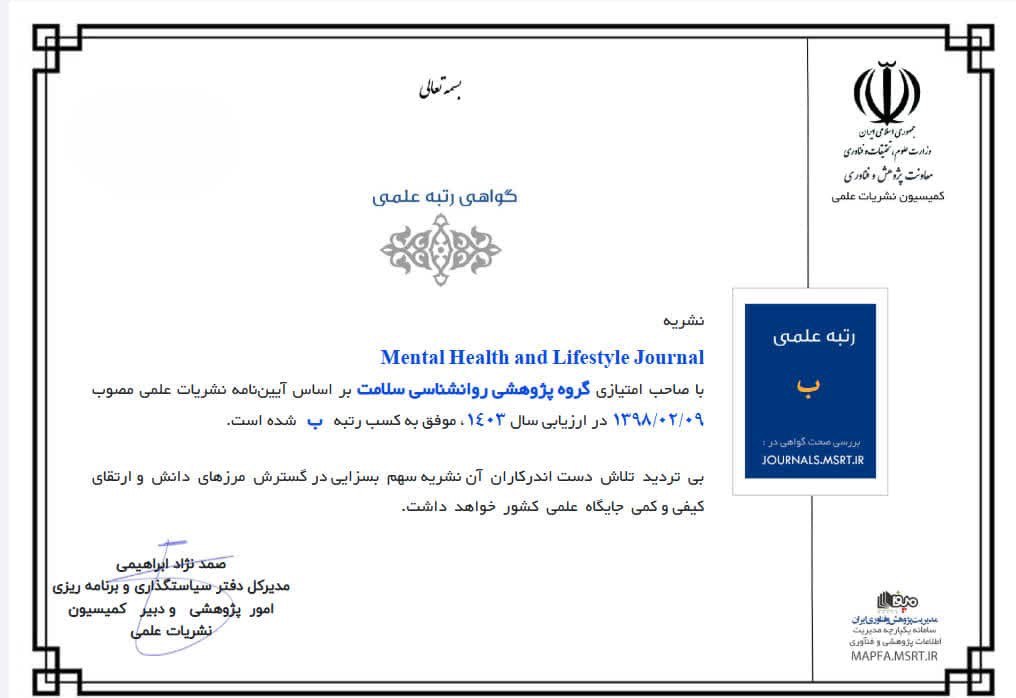
The Effectiveness of Mindfulness-Based Cognitive Therapy on Cognitive Distortions and Suicidal Ideation among Individuals Referring to Counseling Centers
Keywords:
Mindfulness-Based Cognitive Therapy (MBCT), Cognitive Distortions, Suicidal Ideation, Counseling Centers, Psychological Intervention, Mental HealthAbstract
The present study aimed to determine the effectiveness of Mindfulness-Based Cognitive Therapy (MBCT) on cognitive distortions and suicidal ideation among individuals referring to counseling centers. This study employed a quasi-experimental design with a pretest–posttest control group. The statistical population consisted of individuals who referred to the Arsam Psychological Services and Counseling Center in Tonekabon, Iran, in 2025. A total of 28 participants were selected through convenience sampling and randomly assigned to an experimental group (n = 14) and a control group (n = 14). The experimental group participated in eight weekly 90-minute sessions of Mindfulness-Based Cognitive Therapy, while the control group received no intervention. Data were collected using the Cognitive Distortions Questionnaire (CDQ) and the Beck Scale for Suicidal Ideation (BSSI). Data analysis was conducted using descriptive statistics, Levene’s test, and one-way analysis of covariance (ANCOVA). The inferential results demonstrated significant differences between the experimental and control groups at posttest after controlling for pretest scores. ANCOVA revealed that MBCT had a significant effect on cognitive distortions (F = 25.69, p < .001, η² = .47), indicating a substantial reduction in distorted thinking patterns among participants who received the intervention. Likewise, a significant effect was found for suicidal ideation (F = 15.14, p < .001, η² = .45), suggesting that participation in MBCT effectively reduced suicidal thoughts. The results indicate that the intervention accounted for a considerable proportion of the variance in both outcome variables, supporting the efficacy of mindfulness-based cognitive approaches in improving cognitive and emotional functioning. The findings suggest that Mindfulness-Based Cognitive Therapy is an effective psychological intervention for reducing cognitive distortions and suicidal ideation among individuals seeking counseling services. By enhancing present-moment awareness, nonjudgmental observation, cognitive flexibility, and emotional acceptance, MBCT helps individuals disengage from maladaptive cognitive patterns and self-destructive thoughts. Therefore, this therapeutic approach can be recommended as a valuable intervention for promoting psychological well-being and preventing suicide risk in clinical and counseling settings.
Downloads
References
1. Akbari Zardkhaneh S. The Relationship of Suicide with Personality Traits and Life Events. Behavioral Sciences. 2018;3(2):151-7.
2. Bakhtar M, Rezaeian M. Prevalence of Suicidal Ideation and Suicide Attempts and Their Related Risk Factors among Iranian Students: A Systematic Review. Journal of Rafsanjan University of Medical Sciences. 2017;5(11):1061-76.
3. Olfson M, Cosgrove C, Altekruse SF, Wall MM, Blanco C. Deaths of Despair: Adults at High Risk for Death by Suicide, Poisoning, or Chronic Liver Disease in the US. Health Affairs. 2021;40(3):505-12.
4. Renaud J, Berlim MT, McGirr A, Tousignant M, Turecki G. Current Psychiatric Morbidity, Aggression/Impulsivity and Personality Dimensions in Child and Adolescent Suicide: A Case-Control Study. Journal of Affective Disorders. 2018;105(1-3):221-8.
5. Bayrami M, Eghbali A, Gholizadeh H. Personality Interactions with Symptoms of Depression, Hopelessness, and Suicidal Ideation among Students. Medical Journal of Tabriz University of Medical Sciences. 2016;34(1):28-34.
6. Liang J, Kolves K, Lew B, de Leo D, Yuan L, Abu Talib M, et al. Coping Strategies and Suicidality: A Cross-Sectional Study from China. Frontiers in Psychiatry. 2020;11(129):1-10.
7. Gill EG, Quintero JM, Poe L, Moreira AD, Brucato G, Corcoran CM, et al. Assessing Suicidal Ideation in Individuals at Clinical High Risk for Psychosis. Schizophrenia Research. 2015;165:152-6.
8. Goldin PR, Manber-Ball T, Werner K, Heimberg R, Gross JJ. Neural Mechanisms of Cognitive Reappraisal of Negative Self-Beliefs in Social Anxiety Disorder. Biological Psychiatry. 2019;66(12):1091-9.
9. Sharifzadi H. Examining the Effectiveness of Cognitive-Behavioral Therapy on Cognitive Distortion and Depression in Children with Hyperactivity Disorder: University of Bushehr; 2021.
10. Goodarzi H. Comparing the Effectiveness of Internet-Based and Traditional Cognitive-Behavioral Therapy on Emotion Regulation and Cognitive Distortions in Adolescents with Social Anxiety: Roshdieh Institute of Higher Education, Department of Psychology; 2021.
11. Shaban N, Dehghani M, Refati E, Ghorbani S, Amani O. The Effect of Mindfulness-Based Cognitive Therapy on Emotional Self-Awareness and Metacognitive Beliefs in Adolescents with Generalized Anxiety Disorder. Journal of Psychiatric Nursing. 2020;8(5):1-12.
12. Tabatabaei Nejad FS, Ibn Yamin M. The Effectiveness of Mindfulness-Based Cognitive Therapy on Rumination, Quality of Life, Emotion Regulation, and Relationship Beliefs in Women Dissatisfied with Their Husbands. Military Psychology Quarterly. 2020;11(44):31-43.
13. Nowakowska‐Domagała K, Podlecka M, Sadowski K, Pietras T, Mokros Ł. The Relationship Between Chronotype, Dispositional Mindfulness and Suicidal Ideation Among Medical Students: Mediating Role of Anxiety, Insomnia and Social Dysfunction. Journal of Sleep Research. 2023;32(4). doi: 10.1111/jsr.13823.
14. Yuan GF, Zhong S, Liu C, Liu J, Yu J. The influence of family resilience on non-suicidal self-injury among Chinese adolescents: The mediating roles of mindfulness and individual resilience. Archives of Psychiatric Nursing. 2025. doi: 10.1016/j.apnu.2025.01.003.
15. Goodarzi AH, Golmohammadi AA, Bashir Gonbadi S, Samadi S. The Effectiveness of Mindfulness-Based Stress Reduction on Suicidal Thoughts and Aggression in Conscript Soldiers. Police Medicine Quarterly. 2018;7(4):147-52.
16. Darj M. The Effectiveness of Mindfulness Therapy on Suicidal Thoughts and Social Adjustment in Adolescent Girls Who Attempted Suicide. Quarterly Journal of Experimental and Cognitive Psychology. 2024;1(4):154-65.
17. Fan XF, Peng JY, Zhang L, Hu YL, Li Y, Shi Y, et al. The Impact of Mindfulness Therapy Combined with Mentalization-Based Family Therapy on Suicidal Ideation in Adolescents with Depressive Disorder: Randomized Intervention Study. Annals of General Psychiatry. 2024;23(1):16. doi: 10.1186/s12991-024-00503-3.
18. Zeydabadinejad MM, Nouri N, Fatehi Khoshknab L, Malekmohammadi S, Poursadegh Gavgani Z. The Effectiveness of Mindfulness-Based Cognitive Therapy on Cognitive Fusion and Interpersonal Needs in Students With Suicidal Thoughts. Cognitive Psychology Quarterly. 2025;13(2):1-15.
19. Hefazi Torghabeh L, Najafi M. The Relationship between Childhood Trauma and Suicidal Ideation in Students: The Mediating Role of Mentalization and Mindfulness. Journal of Educational Psychology Studies. 2024;21(56):27-51.

Published
Submitted
Revised
Accepted
Issue
Section
License
Copyright (c) 2026 Nasim Komasi , Fatemeh Goleij, Maede Martami (Author); Eshagh SamKhaniani; Elahe GhasemPour (Author)

This work is licensed under a Creative Commons Attribution-NonCommercial 4.0 International License.