Social Innovation and Gender Equity in Sport: A Systematic Review
Abstract
This systematic review considers the nexus of social innovation and gender equity in sport, with specific attention to means of moving towards gender parity in Iranian sport. In accordance with the PRISMA guidelines, the analysis reviewed 25 peer-reviewed journal articles between the years 2010 and 2025 from Scopus, Google Scholar, and Web of Science databases. The research findings indicate that social innovation at an institutional level is the overarching solution for dealing with gender equality in sport worldwide, as 21 out of 25 reviewed studies highlighted structural, organizational, and institutional transformation. The research demonstrates that real change towards gender parity in sport must be derived by reforming existing systems at all levels of framework, policy, and organizational structure as opposed to realizing isolated programs. In the Iranian context in particular, the present analysis indicates that successful gender equity programs need to involve influential stakeholders such as governments, education institutions, and sport federations and address entrenched social and cultural norms as well as oppressive social barriers tending to limit women's participation.
Introduction
In the world of sports, the historical dominance of men remains evident. Gender equality barriers in this domain are predominantly rooted in social structures that associate sports with "masculine" characteristics such as strength, endurance, and speed. This perspective becomes particularly pronounced in competitive and confrontational environments (1). Gender classifications in contemporary sports reflect social and cultural conventions rather than inherent differences. Sports involving strength, endurance, and physical contact have become associated with masculinity, whereas those emphasizing grace, concentration, and flexibility are culturally linked to femininity (2).
The gendering of sports varies across cultures. While physical characteristics of activities play a role in their classification, regional participation patterns—whether sports are dominated by men or women in specific areas—also influence these gendered perceptions (3). Sports have traditionally socialized participants around male-centered ideals of winning and dominance. As a result, young people in athletic and school settings learn gender stereotypes early and carry them forward, sustaining these patterns over time (4). Research indicates that male athletes demonstrate a stronger inclination toward rigid categorization of sports into masculine and non-masculine categories, while women are less likely to accept such limitations (5). Media coverage reinforces the masculine coding of sports by centering male athletes and highlighting physical prowess. This focus sustains existing gender stereotypes and strengthens the cultural association between sports and masculinity (6).
Pierre de Coubertin, the founder of the modern Olympic movement, held a negative attitude toward women's sports, considering them "impractical, uninteresting, unaesthetic, and incorrect" (7). Despite initial efforts to restrict women's participation in the Olympic Games, during the interwar period, women's sports gained importance and women's sports organizations expanded, leading to the addition of women-specific events to the Olympics. In fact, men sought to maintain control over women's sports to prevent its popularity from surpassing men's sports (8). After World War II, social, economic, and legal changes enabled more women to enter professional sports. The international women's sports movement expanded significantly from the 1970s through the 1990s, culminating in the landmark 1994 Brighton Conference on Women and Sport (9).
The conference's achievement was the development of an international treaty supporting the establishment of a gender-equitable sports system, which became known as the "Brighton Declaration" and received support from the International Olympic Committee. By the late nineteenth century, women had gained access to all Olympic disciplines. The 2018 PyeongChang Winter Olympics marked the first instance where the number of women's medal events surpassed men's (9, 10). However, it is noteworthy that despite women's access to all Olympic sports, certain competitions still maintain restrictions. For instance, in athletics until 2017, women were limited to participating in the 20-kilometer race walk, being excluded from the 50-kilometer event.
In societies where gender classification is based on binary structure and historical-cultural power dynamics, "men are considered the primary human standard and foundation of social structure" (11). This masculine framework becomes normalized across society, shaping organizational structures, policies, and practices around male-centered values. In this gender hierarchy that places men and masculinity at the top, women must navigate and adapt to a "masculine world." Sports institutions perpetuate this patriarchal system by marginalizing women and devaluing anyone outside the heterosexual white male norm (12).
In professional sports, women have consistently faced multiple forms of discrimination, including gender segregation, wage inequality, and limited representation in management positions (only 40 percent in sports federation boards). These structural limitations have led to consequences such as limited media coverage, restricted access to financial resources, scarcity of professional women's leagues, and constraints in attracting sponsors (13). Other significant challenges in this domain include the absence of professional women's leagues in certain sports disciplines and the issue of sexual harassment, which severely undermines female athletes' position compared to their male counterparts (14).
One of the significant historical challenges for female athletes has been the difficulty of balancing athletic careers with motherhood. This issue is significant not only from a work-family balance perspective but also concerning the physiological changes associated with pregnancy. This matter becomes particularly crucial in professional sports, where physical capabilities play a vital role (15). Mothers in professional sports encounter widespread discrimination, including exclusion from training and competition during pregnancy or parenthood and contracts with anti-pregnancy clauses. Some organizations take a purely economic stance, terminating pregnant athletes without compensation based on the flawed assumption that pregnancy inevitably diminishes performance and disrupts careers (16).
Gender inequality, as one of the principal challenges in contemporary societies, has consistently impacted women globally, particularly in Iran. This issue has become more pronounced in sports, producing adverse effects on women's athletic participation and achievement. In many societies today, women are deprived of equal opportunities for sports participation and face numerous obstacles. These barriers can be categorized into three main classifications: structural and managerial limitations, financial and resource constraints, and cultural and social restrictions. In Iran, due to the distinctive cultural and social conditions prevalent in society, these limitations manifest more prominently (17).
The word "innovation" comes from the Latin "innorate," meaning to renew, revive, or create something new (18). Innovation as an academic domain primarily emerges from the research of Joseph Schumpeter (1883-1950), an economist widely considered the progenitor of innovation studies (19). Schumpeter defined innovation broadly to include new products, improved quality, novel production methods, untapped markets, fresh materials, and original organizational structures (20, 21).
In Schumpeter's view, innovation was intrinsically linked to commerce, market mechanisms, and competitive positioning, collectively yielding economic profit. Essential to his theory was the necessity of commercializing and market-testing every new idea, process, or product (22). Nevertheless, the concept of innovation has undergone substantial transformation and expansion since Schumpeter's era, currently representing a more comprehensive analytical construct (23). Sports, by virtue of its capacity for adaptation, evolution, and transformation in alignment with sociopolitical and technological developments, inherently embodies an innovative nature (24). This adaptive capability is reinforced through global proliferation, commercialization, and the emergence of novel sporting disciplines originating from athletes' innovative conceptualizations (25). Sports innovation encompasses strategic approaches to addressing specific challenges and requirements, primarily aimed at enhancing individual and organizational performance outcomes. Innovation therefore constitutes an integral component of sports development processes (26).
Nicholls and Murdock have identified three typologies of social innovation: incremental, institutional, and disruptive social innovations (27). Incremental social innovation pertains to marginal and gradual improvements in services or conventional methodologies at the micro-level, targeting social problem resolution for smaller demographic groups, such as enhancing public services to address specific individual needs. Institutional social innovation focuses on organizational and structural modifications aimed at refining existing processes and frameworks. Ultimately, disruptive social innovation refers to fundamental, radical transformations that reconfigure social systems and power dynamics in favor of marginalized populations. However, discerning the precise moment when a change is sufficiently "radical" to qualify as disruptive innovation remains consistently challenging.
Social innovation is a newly emergent field of research, particularly in its application to issues of gender equity in the context of sport. The integration of social innovation concepts with gendered thinking is in its infancy, yet it holds significant potential to tackle structural inequalities (28). This novelty is particularly pronounced in the Iranian landscape of sport, where conventional responses have failed to redress entrenched gender inequalities. Key facilitators and barriers to gender equity in sport are entwined within four themes—personal characteristics, interpersonal support, organisational support, and discrimination—underscoring the complexity of addressing such issues (29). Although the increasing significance of social innovation for sustainable development and gender equity has been emphasized at the European level, equivalent models have not been systematically implemented in non-Western settings such as Iran (30). Gender equality has also been identified as a key transformational factor for Iranian sport in the future, while socio-cultural hindrances for Iranian women in sport remain significant (31, 32). However, there is notably limited scholarship connecting these findings through social innovation thinking. Current research lacks an integrated model for linking social innovation methods with the specific issues of the Iranian context, including religious sensitivities and gender power dynamics influencing women’s participation and presence in sport. Furthermore, although Sport for Development has been analyzed in relation to women’s empowerment programs, insufficient research has explored how social innovation thinking can be systematically embedded in Sport for Development programs to address gender inequities in Iranian sport (33). This research fills the aforementioned gap by generating an integrated theoretical framework for analyzing social innovation categories relevant to the Iranian context, offering evidence-based policies for promoting gender equality in Iranian sport in harmony with cultural sensitivities.
Methods and Materials
The study in this case uses the systematic review research approach to investigate the social innovation and gender equity in sport in terms of the drive towards gender equality in the Iranian sport context. Using the PRISMA approach—established as the international standard in social and management research—the authors ensured an inclusive and objective synthesis of the literature. A wide and thorough search was conducted across some of the most credible scientific databases, such as Scopus, Web of Science, and Google Scholar databases, providing universal access to global scientific research. The PRISMA approach defines a four-step process for systematic literature review: preliminary selection and de-duplication of duplicates; screening using review of article titles and abstracts; eligibility appraisal using review of full-text articles; and selection stage for final choice and analysis of articles.
Identifying the Research Question
The review was guided by the following research questions:
What social innovation strategies promote gender equity in sports?
What are the key barriers to gender equity in sport?
These questions were developed to address gaps in the literature on social innovation as a mechanism for advancing gender equity in sports, focusing on practical interventions and contextual influences.
Search Strategy
An extensive search was undertaken to find relevant studies in several scientific databases, such as PubMed, Google Scholar, and Scopus. The search was narrowed to peer-reviewed journal publications and conferences between the years 2010 and 2025 to capture the most updated developments in the area. The keywords for the search encompassed: "Social Innovation and Gender Equity," "Gender Equity and Sports," and "Social Innovation and Sports." Boolean terms "AND" and "OR" were also utilized to target the search. For instance, "Social Innovation AND Sports AND Gender Equity." Articles were also cross-referenced against key reviews and research article bibliographies to ensure full coverage of the subject matter.
Inclusion and Exclusion
To guarantee the review highlighted high-quality, relevant studies, certain inclusion and exclusion criteria were used in the selection process. The inclusion criteria were as follows:
- Peer-reviewed research published in English
- Articles published between the years 2010 and 2025
- Studies explicitly dealing with social innovation and gender equity programs in sport environments
- Studies analyzing gender parity issues and opportunities in sport
- Empirical studies, review publications, or case studies investigating social innovation in relation to gender equity in sport participation, leadership positions, or fund distribution
- Studies reporting outcomes of gender equity interventions or impacts of social innovation in sport environments
The exclusion criteria were:
- Articles discussing strictly theoretical models with no practical applicability to sports or gender equity
- Non-peer-reviewed publications such as op-ed columns or publications lacking rigorous scientific research methodologies
- Studies discussing universal applications of social innovation in unrelated industries without direct relationships to sport or gender equity
Data Extraction and Synthesis
Once the relevant articles were identified, we applied a standard data extraction procedure to extract key details from each article. The extracted information included: study details (author(s), year of publication, journal name); nature of social innovation initiative; and specific dimensions of gender equity addressed. This was categorized under thematic themes in terms of the main focus of each study: social innovation mechanisms, gender equity initiatives, cultural and institutional barriers, and policy solutions. The data extraction tool had the following fields in Persian and English: "Article code," "Authors," "Year," "Title," "Type of innovation," and "Description of innovation." The findings were synthesized and presented to identify general themes, innovative strategies, and new directions in using social innovation to address gender equity issues in sport settings.
Quality Rating
A quality appraisal was conducted against established standards for ensuring the validity and reliability of included studies in the review. The rigor of each study, sample size, suitability of conceptual frameworks utilized, and the strength of the findings were examined. A review of how studies handled complex relationships between social innovation, gender equity, and sport was considered. Those with serious methodological flaws, such as small sample sizes and low generalizability, were documented.
Limitations of the Review
The limitations of the review include the risk of publication bias because peer-reviewed publications were the focus, potentially omitting related work published in gray literature or non-academic sources. The review was also constrained to studies in the English language only, which possibly excluded relevant research published in other languages. Additionally, due to the complexity and dynamic nature of social innovation and gender equity concepts, definitions, and strategies differed across studies, making direct comparison difficult.
Findings and Results
The initial search identified 171 articles, which were then whittled down to 86 after a title and abstract review. Further text examination whittled down these 86 articles to 25 eligible for the study. This rigorous and systematic process ensures the scientific status of the research and that only articles of best quality and relevance have been considered.
Records identified through database searching (n = 171)
Titles and Abstracts Screened (Stage One)
(n = 171)
Full-text articles assessed for eligibility (Stage Two) (n = 86)
Papers excluded after title/abstract review
(n = 85)
Full-text papers excluded with reasons:
(n = 61)
- Strictly theoretical models only
- Not directly related to sport or gender equity
- Lack of rigorous methodology
Studies included in systematic review (n = 25)
Quality Assessment Conducted Rigor, sample size, conceptual frameworks, and strength of findings evaluated All 25 studies met quality criteria
Data was extracted from each study, including the article code, authors, publication year, and title. For each study, the type of innovation was identified and categorized, along with a detailed description of the innovation being examined.
Figure 1. PRISMA Flow Diagram for Systematic Review Selection Process
To provide a comprehensive overview of the selected literature, the key characteristics and findings of each study are summarized in Table 1. This table presents the essential details extracted from each study, including author information, publication year, innovation type, and detailed descriptions of the social innovations examined.
Authors | Year | Title | Type of Innovation | Description of Innovation | |
|---|---|---|---|---|---|
A-1 | Zipp, Sutherland & de Soysa | 2022 | Innovative approaches to menstrual health and sport for development: Menstrual matters. | Institutional Social Innovation | innovative approaches aimed at transformation at organizational and institutional levels. |
A-2 | Cukier, Chavoushi & Mo | 2023 | Social innovation to advance diversity and inclusion | Institutional Social Innovation | These approaches emphasize "equity, diversity, and inclusion concerns at broad structural levels, seeking to enhance representation of historically marginalized groups and eliminate barriers to their full participation in social, political, cultural, and economic spheres. |
A-3 | Kraft, Culver & Din | 2022 | Increasing gender equity in sport organizations: assessing the impacts of a social learning initiative | Institutional Social Innovation/ Incremental Social Innovation | The phenomenon may incorporate multiple dimensions simultaneously. Specific initiatives targeting girls could represent incremental innovation, while establishing long-term organizational change embodies aspects of institutional innovation. This classification is appropriate because it addresses. |
A-4 | Adami & Fitch | 2021 | The innovative role of Olympic sports and exercise in the promotion of health, gender equality and sustainability: past achievements and future challenges. | Institutional Social Innovation | This addresses "modifications and improvements at organizational and institutional levels intended to reform existing structures and processes." The emphasis on the role of influential large-scale organizations, such as international sports federations, in facilitating widespread social transformation demonstrates the institutional orientation of this innovation paradigm. |
A-5 | Sarkki et al | 2024 | Women-led social innovation initiatives contribute to gender equality in rural areas: grounded theory on five initiatives from three continents. | Incremental Social Innovation | References to "woman-to-woman networks and self-organization" indicate a micro-level, localized problem-solving methodology. The focus on "tangible, quotidian realities of women" reflects attention to gradual enhancements in daily lived experiences. |
A-6 | Burnett | 2018 | Politics of gender (in) equality relating to sport and development within a sub-Saharan context of poverty. | Institutional Social Innovation | Article concentrates on "ideology, culture, significant others, resource accessibility, and democratic systems" that shape women's and girls' experiences, illustrating attention to structural and institutional determinants. |
A-7 | Longa | 2025 | Gender Equality within the Sports Legal Framework: A Comprehensive Analysis and Future Perspectives. | Institutional Social Innovation | The scholarship identifies awareness campaigns and policy initiatives designed to reform existing frameworks and address cultural-institutional impediments to progress. |
A-8 | Svensson | 2023 | Innovation studies-Social transformation in sport for development. | Institutional Social Innovation/ Incremental Social Innovation | The article explicitly emphasizes "meaningful frameworks and intra-organizational conditions for facilitating innovation," which demonstrates an effort to create structural changes at the organizational level. Furthermore, the text references "community-based non-profit organizations," indicating work at the micro and local levels. |
A-9 | Vaquero-Cristóbal et al | 2024 | Gender equity in sport from the perspective of European women athletes and sport managers, physical education teachers and sport coaches. | Institutional Social Innovation | The study seeks macro-level solutions that include "establishing supportive policies and regulations" and "strengthening female leadership." These elements indicate efforts toward change at the institutional and structural levels. |
A-10 | Næss & Tjønndal | 2021 | Managing social innovation in sport. In Innovation, Sustainability and Management in Motorsports: The Case of Formula E | Incremental Social Innovation | This approach differs from focusing on extensive structural changes in automotive racing, as the latter only offers incremental and limited improvements for a specific group (female drivers). |
A-11 | Sarkki et al | 2021 | Reconstructive social innovation cycles in women-led initiatives in rural areas. | Institutional Social Innovation | The article explicitly mentions "change at the levels of daily operations, institutions, and cognitive frameworks," demonstrating efforts to transform institutionalized systems. |
A-12 | De Soysa & Zipp | 2019 | Gender equality, sport and the United Nation’s system | Institutional Social Innovation | The article addresses the efforts of significant international organizations such as UNESCO, the International Olympic Committee, and the International Working Group on Women and Sport, which operate at the institutional level to create structural changes in gender equality in sports. This type of effort occurs at the institutional and organizational level, aiming to reform existing structures and processes. |
A-13 | Lindberg & Berglund | 2016 | ‘Gendered social innovation’: a new research stream for gender-inclusive innovation policy, research and practice. | Institutional Social Innovation | The article focuses on establishing a new research trajectory called "gender social innovation," which aims to transform existing social structures. This type of innovation operates at the institutional level and seeks to reform existing structures and processes in society. The text explicitly refers to "transforming social structures in society" as one of the main objectives of this study, which is a prominent characteristic of institutional social innovation. |
A-14 | Singh, Singh & Kaur | 2022 | Relationship between propensity to social innovation and striving for gender equality: sample study based on the example of India | Institutional Social Innovation | The study explicitly asserts that "gender plays a significant role in the implementation of social innovations in India," and the extent of social innovation implementation for gender equality varies with other demographic variables. This indicates a necessity for transformation in existing social structures and institutionalized systems. |
A-15 | Lindberg, Forsberg & Karlberg | 2015 | Gendered social innovation-a theoretical lens for analysing structural transformation in organisations and society. | Institutional Social Innovation | The proposed theoretical framework entitled "Gender Social Innovation" aims to identify unresolved social challenges related to gender inequality and unmet needs among underrepresented or marginalized groups. This approach demonstrates an effort to reform existing structures and processes at the macro and institutional levels. |
A-16 | Kwieciński | 2022 | Gender equality and innovation–towards sustainable development and social innovation using the example of activities undertaken by the European Union | Institutional Social Innovation | The article analyzes the importance of gender equality in the context of implementing social innovations and sustainable development principles, examining these processes at the European level and within European institutions. This represents a macro-institutional approach seeking to transform existing structures and systems. |
A-17 | Schiebinger | 2021 | Gendered innovations: integrating sex, gender, and intersectional analysis into science, health & medicine, engineering, and environment | Institutional Social Innovation | The article examines the "Gender Innovations" project, which aims to create fundamental changes in research methodologies in natural sciences and engineering through the development of gender analysis and intersectional methods. This approach seeks change at the institutional and structural level, rather than merely minor improvements in existing services or methodologies. |
A-18 | Ratten | 2019 | Social innovation in sport: The creation of Santa Cruz as a world surfing reserve | Institutional Social Innovation | This research investigates the World Surfing Reserves program, an organized initiative for protecting cultural and environmental areas associated with surfing. This program, implemented by the Save the Waves organization, aims to create change at the structural and institutional level. |
A-19 | Jenkins | 2019 | Gendered innovation in the social sciences | Institutional Social Innovation | The article explicitly references "new norms and new knowledge," indicating fundamental changes in knowledge systems and scientific structures. These changes extend beyond incremental improvements and seek to transform core perspectives in social science disciplines. |
A-20 | Pécot et al | 2024 | From empowering women to being empowered by women: A gendered social innovation framework for tourism-led development initiatives | Institutional Social Innovation | The article states that tourism-based development narratives often focus on individual empowerment of women while ignoring underlying gender inequalities and "broader social changes needed." This indicates that the study seeks changes at the institutional and structural levels. |
A-21 | Cunha et al | 2024 | Innovation or social progress? An analysis of the predictors for worldwide advancement of gender equality | Institutional Social Innovation | This study examines the relationship between innovation and social progress for advancing gender equality at the global level, demonstrating a macro-level and institutional approach. The researchers have collected secondary data from reputable global indices (Global Innovation Index, Social Progress Index, and Global Gender Equality Index), indicating a focus on changes at the structural and institutional levels. |
A-22 | Veckalne &Tambovceva | 2023 | The importance of gender equality in promoting entrepreneurship and innovation | Institutional Social Innovation | The study explicitly concentrates on changes at the structural and institutional levels. The abstract explicitly references "deeply rooted social norms and biases that disproportionately affect women" and notes that these barriers extend beyond limited access to resources. This demonstrates a focus on reforming existing structures and processes at the macro level. |
A-23 | Börjesson et al | 2016 | Visualizing gender–Norm-critical design and innovation | Institutional Social Innovation | The study investigates how norm-disruptive design with a gender perspective can be utilized to reveal norms and facilitate innovation. This approach operates through "challenging the existing order" and "what is taken for granted," indicating efforts toward change at the structural and institutional levels. |
A-24 | Bunde-Birouste, Richmond & Kemp | 2021 | Sports as social innovation for social inclusion | Institutional Social Innovation | This research examines the Football United Australia program, which is a "complex health promotion initiative" that utilizes football mechanisms to create social cohesion, racial harmony, and social participation. This program operates at a broad and organized level, aiming to create structural changes in society rather. |
A-25 | Saska & Baruah | 2016 | Bridging Social Innovation and Gender Equality: Possibilities and Pitfalls | Institutional Social Innovation | This study investigates the connection between social innovation and gender equality, explicitly noting that "almost no effort has been made to connect these two domains." This demonstrates an effort to create change at the structural and institutional level, as it seeks to link two important theoretical and practical domains that have previously been "completely separate. |
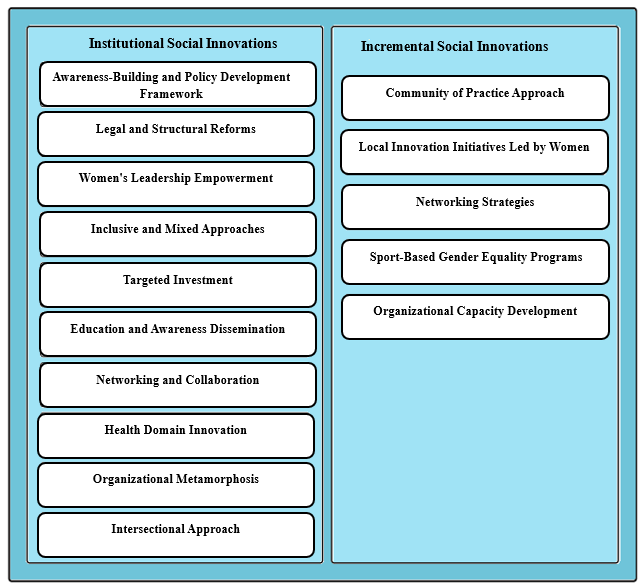
Identified Institutional Social Innovations:
1. Awareness-Building and Policy Development Framework
This innovation involves creating multi-pronged strategies for increasing women's involvement in sport. The ultimate goal is to bring about deep change in social and institutional mindsets toward women in the realm of sport. This strategy involves creating media initiatives, conducting expert conferences, developing educational materials, and facilitating public debate on the importance of gender equity in sport. Awareness creation is the focus of all these activities and it lays the foundation for structural and cultural changes.
2. Legal and Structural Reforms
This innovation outlines an in-depth process for the review of current laws and structures in sports. Its aim is to target and eradicate all discriminatory elements in management systems in sport. This involves the amendment of rules, formulation of new guidelines, implementation of specific monitoring systems, and establishment of absolute equality in opportunity, resources, and facilities. In addition, it requires women's involvement in decision-making and management.
3. Women's Leadership Empowerment
This strategy goes beyond having more women in sport; it seeks to develop career advancement and leadership opportunities for them. The idea is to shatter the glass ceiling and provide equal opportunities for women to obtain managerial and strategic roles in sport organizations. The strategy involves training programs, empowerment seminars, economic and moral support, and the development of professional networks for nurturing female leaders in the sport sector.
4. Inclusive and Mixed Approaches
The idea of this innovation is to eliminate conventional gender lines and bring about fully equal sport settings. This process involves developing sports activities in such a way as to promote participation irrespective of gender. Developing mixed competitions and matches, reformulating standards and rules, and ensuring equal opportunity for all people are the main pillars of this process.
5. Targeted Investment
It focuses on fair allocation of human and financial resources. The emphasis is on redressing previous shortcomings in support for women's sport. This entails increasing research budgets, offering monetary support for women's clubs and teams, establishing infrastructure and facilities, as well as creating incentive systems for private sector funding.
6. Education and Awareness Dissemination
The strategy emphasizes the necessity for attitude change through education. The approach is designed to overcome gender stereotypes and prejudice through extended educational programs. This multi-faceted approach entails curriculum development at all educational levels, organizing specialized workshops, producing media materials, and encouraging public discourse in order to achieve social attitude change.
7. Networking and Collaboration
This innovation emphasizes the necessity of cross-sector collaboration. The vision is to bring in specialized networks and have them share experiences and knowledge. The process requires organizing specialized gatherings, establishing online platforms, providing funding for collaborative research initiatives, and forming specialized working teams to come up with innovative solutions.
This policy targets women's health and physiological concerns in sport. The intention is to diminish social stigma and offer specialized services. The policy consists of specialized training, providing health infrastructure, offering nutritional and psychological consultations, as well as providing support services for women athletes.
9. Organizational Metamorphosis
This innovation addresses the need for change in internal organizational structures. The aim is to rebuild organizational culture and develop new managerial perspectives. The approach involves evaluating hierarchical systems, increasing transparency, creating participatory systems, and reinforcing the culture of equality at all organizational levels.
This approach goes beyond the single-dimensional conception of gender equality to address identity diversity. The aim is to identify and combat multidimensional discrimination. The approach entails awareness of ethnic, class, disability, and sexual orientation variations in addition to gender, and seeks to promote fully inclusive environments devoid of all forms of discrimination.
Identified Incremental Social Innovations:
1. Community of Practice Approach
The Community of Practice approach in sport is an innovative way of generating interactive platforms and shared learning among professionals. The approach goes beyond the conventional mutual collaboration to concentrate on generating an interactive web of sport leaders, coaches, and professionals. The main target is enabling the sharing of experiences, knowledge, and practical solutions aimed at widening the involvement of women and marginalized communities in sport. In the approach, professionals examine problems, establish opportunities, and develop innovative solutions through specialized meetings and combined workshops and Internet platforms. The greatest accomplishment of the approach is generating shared and strategic discourse in redressing gender disparities in sport.
2. Local Innovation Initiatives Led by Women
Local women's innovation initiatives are an inclusive strategy for dealing with gender disparities in rural and peripheral settings. The initiative targets three main fields—employment, education, and the reframing of patriarchal gender roles—aiming for root transformations in women's status. In this process, women act as agents of change at the local level by defining the capacities of the area and designing education packages suited to indigenous needs, empowering themselves as well as their area. Designing women-centric business models and calling into question conventional beliefs are other vital strategies of the initiative. The overall objective of the initiative is to enhance women's status and bring about parity of opportunity in all fields. This strategy with its internal and external empowerment of women serves as the basis for structural as well as cultural changes capable of significantly influencing the betterment of women's living standards.
Networking strategies constitute an integral part of women's empowerment in terms of reinforcing women's self-esteem and economic independence. The strategy emphasizes women's relationships with one another and the generation of support networks. Interactive platforms and empowerment workshops form the core of self-organization and skill building of social and individual abilities among women. Encouraging women's enterprise and economic and social support systems are other integral elements of the strategy. The ultimate target is for strong support networks to empower women to break through social barriers and promote their advancement.
4. Sport-Based Gender Equality Programs
Sport for gender equality programs is an innovative solution to gender barrier breaking and equal opportunity generation. Sport is viewed as an influential vehicle for gender equality through the utilization of well-designed programs. The "Dare to be Different - Girls on Track" initiative in motorsport is a clear case. Sport for gender equality programs allow women to enter sport fields through the introduction of specialized women's competitions for male-dominated sports and offering routes for career development. The objective is to smash social and cultural barriers and offer infrastructure and specialized support for women. Not only does it develop women's sport skills, but it also contributes considerably to transforming social attitudes towards women's abilities.
5. Organizational Capacity Development
Organizational capacity building is a strategic methodology to empower social and not-for-profit organizations. This innovation is aimed at enabling small organizations to discover new systems of operations and tackle social issues with limited resources. Strategic management training, innovation mechanism building through minimal resources, and innovation in approaching social issues are all of primary importance in the approach. Its primary function is to make the organization more adaptable and enhance the efficiency of social institutions. The approach enables organizations to overcome resource constraints through creative and innovative means and develop lasting solutions for social problems.
Discussion and Conclusion
This systematic review of 25 articles confirms that institutional social innovation is the most common strategy for advancing gender equality in sport worldwide. It appears from the findings that gender equality in sport necessitates transformation at the structural, organizational, and institutional level, and not through stand-alone interventions.
For Iran's sports landscape specifically, these findings present several significant implications. First, sustainable advancement of gender equality in Iranian sports likely necessitates comprehensive reforms to existing frameworks, policies, and organizational structures, similar to the institutional approaches documented in studies referencing awareness campaigns and policies aimed at reforming existing structures and addressing cultural-institutional barriers (34). Further support for this interpretation can be found in work examining the efforts of significant international organizations such as UNESCO, the International Olympic Committee, and the International Working Group on Women and Sport, which operate at the institutional level to create structural changes in gender equality in sports (35, 36). These institutional and organizational-level efforts target the reformation of existing structures and processes, rather than merely incremental service improvements. Second, while incremental innovations may provide immediate benefits for specific groups of female athletes or participants, this research suggests they should be integrated into broader, systematic change efforts to achieve sustainable impact.
This study also highlights the need for overcoming ingrained social norms and cultural obstacles that disproportionately affect the sport participation of women. As ideology, culture, significant others, resource availability, and democracy influence the lives of girls and women, and as developing encouraging policies and legislation and enhancing women's leadership remain central concerns, successful gender equality projects in sport need to interact with the ideology, culture, and structure that construct the experience of women (37, 38). In the Iranian scenario, this suggests the need for multi-level interventions that work on multiple layers at once, simultaneously influencing policy structures, organizational procedures, and social attitudes toward women in sport. Women-led projects contribute towards gender equality through problem-solving practices rooted in the local context that work on the real, “here and now” issues confronting girls and women in sport (39). Such projects can prove especially useful in the Iranian scenario, where socially embedded and culturally sensitive practices may be able to negotiate complicated social complexities while facilitating meaningful action at the local, grassroots level.
The intersection between innovation and social progress provides another important dimension for examination in the Iranian context (40). Analysis at the global level indicates that gender equality must be advanced through attention to innovative methods as well as through broader social development measures. For Iran, this could translate into framing gender equality efforts in the realm of sport as part of broader social development objectives in order for them to be as effective and sustainable as possible. Research into the application of gender-sensitive norm-critical design in order to uncover norms and innovate clearly presents avenues for overcoming entrenched gendered assumptions in sport (41). In the Iranian context, such an approach may prove specifically useful, insofar as the achievement of sport-based gender equality might depend on the development of innovative avenues for uncovering and questioning existing norms while being sensitive to the local culture.
The prevalence of institutional social innovation in the analyzed literature (21 out of 25 articles) demonstrates that transformative change requires engagement with and modification of existing power structures. For Iran, this means that efforts to achieve gender equality in sports must involve key stakeholders including national sports federations, educational institutions, governmental bodies, and international organizations. As demonstrated in previous studies, influential large-scale organizations can facilitate widespread social transformation through policy initiatives and awareness campaigns designed to reform existing frameworks (10, 30).
As such, this study contributes to existing literature on gender equality in sport through synthesizing existing strategies and laying the groundwork for targeted application in Iran. The conclusions indicate that the attainment of gender equality in Iranian sport necessitates holistic, multi-level interventions that integrate institutional change and incremental innovations, involve multiple stakeholders, and operate in concert with deeply ingrained cultural norms while being responsive to the specificity of Iranian social culture. Future practical work and work in the academy could learn from cross-cultural application of successful models while creating indigenous strategies targeted at local realities. Finally, building stronger links between wider social innovation practices and gender equality work is an avenue for advancing gender equality in Iranian sport that holds much promise.
Acknowledgments
The authors express their deep gratitude to all participants who contributed to this study.
Authors’ Contributions
All authors equally contributed to this study.
Declaration of Interest
The authors of this article declared no conflict of interest.
Ethical Considerations
The study protocol adhered to the principles outlined in the Helsinki Declaration, which provides guidelines for ethical research involving human participants.
Transparency of Data
In accordance with the principles of transparency and open research, we declare that all data and materials used in this study are available upon request.
Funding
This research was carried out independently with personal funding and without the financial support of any governmental or private institution or organization.
References
- 1. Amin S, Mbah O, Mateo-Orcajada A, Albaladejo-Saura M, Vaquero-Cristóbal R. European handbook for gender equality, equity, inclusion in sport: A perspective through the Erasmus+ Women-Up project. Madrid: Dykinson; 2023.
- 2. Yang Y, Siu TW. Mind-body harmonization: Women's sports participation and social transformation in modern China. The Journal of Chinese Sociology. 2025;12(1):5. doi: 10.1186/s40711-025-00231-5.
- 3. Primanata D. Cultural perceptions of gender equality in sports and its influence on female athlete participation. Gladi: Jurnal Ilmu Keolahragaan. 2024;15(4):455-65. doi: 10.21009/GJIK.154.02.
- 4. Parsons JL, Akinrolie O, Loewen H, Coen SE. Gendered sport environments and their theoretical contributions to women's ACL injury risk: A scoping review. medRxiv. 2024. doi: 10.1101/2024.10.09.24315187.
- 5. Hardin M, Greer J. The influence of gender-role socialization, media use and sports participation on perceptions of gender-appropriate sports. Journal of Sport Behavior. 2009;32:207-26.
- 6. Vai A, Setiawan C, Ngatman N, Lardika RA, Noviana E, Yusuf J, et al. Analysis of the representation of female athletes in sports media: A systematic literature review. Retos. 2025;63:918-27.
- 7. Coubertin P. The women at the Olympic Games. In: Müller N, editor. Olympism: Selected Writings. Lausanne: IOC; 1912.
- 8. Krieger J, Krech M, Pieper L. Our sport: The fight for control of women's international athletics. International Journal of the History of Sport. 2020;37:451-72. doi: 10.1080/09523367.2020.1754201.
- 9. Williams SE, Green DM. Let her play: An analysis of Title IX and the development of the modern female. Equity in Education & Society. 2024;3(1):33-45. doi: 10.1177/27526461231187145.
- 10. Adami PE, Fitch K. The innovative role of Olympic sports and exercise in the promotion of health, gender equality and sustainability: Past achievements and future challenges. The Journal of Sports Medicine and Physical Fitness. 2021;61(8):1042-51. doi: 10.23736/s0022-4707.21.12721-5.
- 11. Sveinson K, Taylor E, Keaton AC, Burton L, Pegoraro A, Toffoletti K. Addressing gender inequity in sport through women's invisible labor. Journal of Sport Management. 2022;36(3):240-50. doi: 10.1123/jsm.2021-0229.
- 12. Bevan N, Jeanes R. Queering a community sports club in Australia: A case study of gender inclusion. International Review for the Sociology of Sport. 2025:10126902251333085.
- 13. Torres Romay ET, Mirón García S. Female sports sponsorship: Current situation and trends. Communication and Gender. 2020;2(3):125-37. doi: 10.5209/cgen.70373.
- 14. Association for Women in Professional S, Thomson Reuters F. White paper to promote fair and equitable treatment of women as professional athletes. Thomson Reuters Aranzadi, 2020.
- 15. Hinojosa-Alcalde I, Soler S, Vilanova A, Norman L. Balancing sport coaching with personal life: Is that possible? Apunts Educación Física y Deportes. 2023(154):34-43. doi: 10.5672/apunts.2014-0983.es.(2023/4).154.03.
- 16. Hewitt CM, Campbell MK, Choi YH, Thornton JS. Exploring the postpartum return to sport and performance in Canadian elite athletes. Frontiers in Sports and Active Living. 2025;7:1665212. doi: 10.3389/fspor.2025.1665212.
- 17. Nazari Azad M, Talebpour A, Kashani M. Sociological analysis of gender inequality in sports: From the perspective of female national champion athletes. Women and Society. 2019;10(4):289-315.
- 18. Berger-Soraruff A. The decline of innovation and the rise of contribution. Cultural Politics. 2024;20(3):413-31. doi: 10.1215/17432197-11321265.
- 19. Fagerberg J, Mowery DC, Nelson RR. The Oxford Handbook of Innovation: Oxford University Press; 2005.
- 20. Schumpeter JA. American institutions and economic progress. Zeitschrift für die gesamte Staatswissenschaft/Journal of Institutional and Theoretical Economics. 1983(2):191-6.
- 21. Allen RT, McDonald RM. Methodological pluralism and innovation in data-driven organizations. Administrative Science Quarterly. 2025;70(2):403-43. doi: 10.1177/00018392251313737.
- 22. Ebner A. Innovation in economic evolution: Reintroducing Schumpeterian thought to current advances in economic sociology. Current Sociology. 2025;73(2):262-80. doi: 10.1177/00113921241271850.
- 23. Tjønndal A. Social Innovation in Sport. New York: Palgrave Macmillan; 2021.
- 24. Ratten V, Ferreira JJ. Sport entrepreneurship and innovation: Concepts and theory. In: Ratten V, Ferreira JJ, editors. Sport Entrepreneurship and Innovation. London: Routledge; 2016.
- 25. Tjønndal A. Idrett, innovasjon og sosial inkludering: Fremveksten av Mixed Martial Arts i Norge. Scandinavian Sport Studies Forum. 2018;9:1-24.
- 26. Jinkins L. Book review: Inventing for Sports. Sports Innovation Journal. 2025;6:15-6. doi: 10.18060/29169.
- 27. Nicholls A, Murdock A. Social Innovation: Blurring Boundaries to Reconfigure Markets. Basingstoke: Palgrave Macmillan; 2012.
- 28. Lindberg M, Berglund KE. Gendered social innovation: A new research stream for gender-inclusive innovation policy, research and practice. Research Handbook on Gender and Innovation: Edward Elgar Publishing; 2016. p. 214-26.
- 29. Dadswell K, Mandicos M, Flowers EP, Hanlon C. Women from culturally diverse backgrounds in sport leadership: A scoping review of facilitators and barriers. Journal of Sport and Social Issues. 2023;47(6):535-64. doi: 10.1177/019372352211346.
- 30. Kwieciński L. Gender equality and innovation: Towards sustainable development and social innovation using the example of activities undertaken by the European Union. Przegląd Europejski. 2022(4):11-28.
- 31. Farokhshahinia R. Women's sports and sustainable development: Explaining the role and position of a key driver for gender equality in the future of Iranian sports. Research in Sport Management. 2024;13(13):87-114. doi: 10.22054/qrsm.2024.82764.160.
- 32. Abdolmaleki H, Khalili B, Zarsineh F, Sadeghi M, Fathi Z. Gender inequality in sports endorsement; identifying the obstacles to the presence of Iranian female athletes in sports advertisements. Sports Marketing Studies. 2023;4(1):1-12. doi: 10.22034/sms.2023.62665.
- 33. Javani V. Sport and gender equity: The case of Iran. International Perspectives on Sport for Sustainable Development. Cham: Springer International Publishing; 2022. p. 181-93.
- 34. Longa FEA. Gender equality within the sports legal framework: A comprehensive analysis and future perspectives. Open Journal of Social Sciences. 2025;13(2):516-20. doi: 10.4236/jss.2025.132029.
- 35. De Soysa L, Zipp S. Gender equality, sport and the United Nation's system: A historical overview of the slow pace of progress. Sport in Society. 2019;22(11):1783-800. doi: 10.1080/17430437.2019.1651018.
- 36. Zipp S, Sutherland S, de Soysa L. Innovative approaches to menstrual health and sport for development: Menstrual matters. Social Innovation, Entrepreneurship, and Sport for Development and Peace: Routledge; 2022. p. 189-201.
- 37. Burnett C. Politics of gender (in)equality relating to sport and development within a sub-Saharan context of poverty. Frontiers in Sociology. 2018;3:27. doi: 10.3389/fsoc.2018.00027.
- 38. Vaquero-Cristóbal R, Mateo-Orcajada A, Dağlı Ekmekçi YA, Pereira A, Amin S, Meroño L, et al. Gender equity in sport from the perspective of European women athletes and sport managers, physical education teachers and sport coaches. Frontiers in Psychology. 2024;15:1419578. doi: 10.3389/fpsyg.2024.1419578.
- 39. Sarkki S, Ludvig A, Fransala J, Melnykovych M, Živojinović I, Ravazzoli E, et al. Women-led social innovation initiatives contribute to gender equality in rural areas: Grounded theory on five initiatives from three continents. European Countryside. 2024;16(4):534-62. doi: 10.2478/euco-2024-0028.
- 40. Cunha VBDC, Nascimento TC, Silva RA. Innovation or social progress? An analysis of the predictors for worldwide advancement of gender equality. Cadernos EBAPEBR. 2024;22:e2022-0313. doi: 10.5281/zenodo.8370557.
- 41. Börjesson E, Isaksson A, Ilstedt S, Ehrnberger K. Visualizing gender: Norm-critical design and innovation. Research Handbook on Gender and Innovation: Edward Elgar Publishing; 2016. p. 252-74.